
Astronomy & Space
396 sites

http://solstation.com/life.htm
SolStation.com hosts detailed information about nearby star systems and the search for extraterrestrial life, making it a rich reference for amateur astronomers and space enthusiasts. The site explores the habitability of star systems within our cosmic neighborhood, combining scientific data with accessible writing.
https://people.ast.cam.ac.uk/~jds
The British Astronomical Association Comet Section is a dedicated resource for tracking newly discovered comets, periodic comets, and observational reports from contributors worldwide. Maintained by director Nick James and visual observations coordinator Jonathan Shanklin, the site features comet ephemerides, discovery news, observing guides, and an archive of the newsletter 'The Comet's Tale'.
https://astronomy-links.net/MarsColonies.html
Clark M. Thomas presents a critical essay arguing against the viability and ethics of Mars colonization, countering popular arguments with Malthusian population theory and opportunity cost reasoning. The piece challenges billionaire-backed space colony fantasies by urging focus on Earth's existing ecological and humanitarian crises instead.
http://allthesky.com/
Created by Till Credner and Sven Kohle, AllTheSky.com is a stunning astrophotography gallery spanning comets, nebulae, galaxies, constellations, aurora borealis, and atmospheric phenomena. The site offers an impressive breadth of celestial imagery including nightscapes, 360-degree views, live all-sky feeds, and articles that make it a rich destination for astronomy enthusiasts.
http://panther-observatory.com/
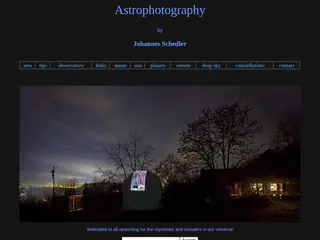
Johannes Schedler's Panther Observatory showcases stunning astrophotography covering the moon, sun, planets, comets, deep sky objects, and constellations, including imaging results from a semi-professional remote observatory at CTIO in Chile. The site also invites visitors to stay at a guest house in Altaussee, Austria, offering dark skies and alpine observing facilities.
http://hawastsoc.org/
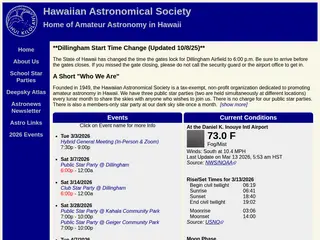
The Hawaiian Astronomical Society, founded in 1949, is a non-profit club dedicated to promoting amateur astronomy across the Hawaiian Islands, hosting regular public and members-only star parties at locations like Dillingham Airfield, Kahala Community Park, and Geiger Community Park. The site features event schedules, a deep-sky atlas, an astronomy newsletter, school star party programs, and live solar and lunar data feeds.
https://cosmotography.com/images/rc.html
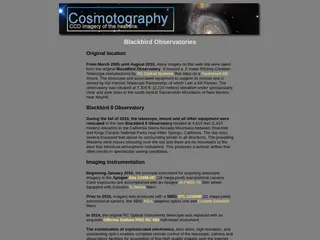
R. Jay GaBany's Blackbird Observatory page details the technical setup behind his acclaimed astrophotography work, including a half-meter Ritchey-Chretien telescope, professional CCD cameras, and two remote observatory locations in New Mexico and the California Sierra Nevada. The site is a fascinating window into serious amateur deep-sky imaging, covering instrumentation, elevation advantages, and the evolution of the observatory from 2005 through 2014.

https://fedastro.org.uk/
The Federation of Astronomical Societies is a UK-based umbrella organization connecting amateur astronomy clubs and societies across Britain. It serves as a hub for coordinating events, sharing resources, and supporting the broader community of stargazers and astronomical enthusiasts in the region.
https://gb.nrao.edu/~rmaddale/Education/OrionTourCenter/index.htm
Created by Ronald J. Maddalena of the National Radio Astronomy Observatory, this interactive tour guides visitors through the Orion constellation using five images captured at different wavelengths including optical, infrared, and radio. Visitors can explore astronomical objects in Orion, learn the mythology behind the hunter, take a glossary-supported test, and see how the same region of sky looks dramatically different depending on the telescope used.
https://stellafane.org/
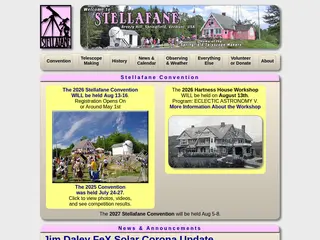
Stellafane is the historic home of the Springfield Telescope Makers of Vermont, hosting one of the oldest and most celebrated amateur telescope making conventions in the world. The site offers comprehensive guides on building Dobsonian telescopes and grinding mirrors, a rich archive of convention history, an astrophoto gallery, and resources for beginners getting started in amateur astronomy.