
Astronomy & Space
396 sites
https://skywatch.brainiac.com/astroland
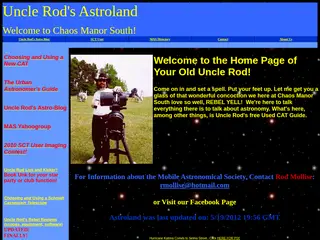
Uncle Rod Mollise's Astro Land is a long-running amateur astronomy hub hosted at 'Chaos Manor South,' packed with telescope guides, equipment reviews, CCD and webcam imaging tips, and resources for Schmidt-Cassegrain telescope users. Rod also runs the Mobile Astronomical Society and offers a free Used CAT Buyer's Guide, making this a genuinely useful stop for backyard astronomers of all levels.

https://mvas-ny.org/
The Mohawk Valley Astronomical Society (MVAS) has been connecting amateur astronomers in Central New York since 1989, offering public stargazing events, monthly meetings, and access to the Barton-Brown Observatory. The site includes astro photos, beginner tips, a newsletter archive, and a full schedule of club events and star parties for members and the public alike.
https://joshworth.com/dev/pixelspace/pixelspace_solarsystem.html
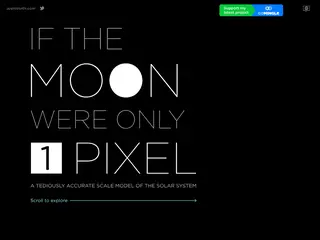
Created by Josh Worth, this site presents a scale model of the solar system where the Moon is reduced to a single pixel, requiring visitors to scroll endlessly through vast empty space to appreciate the true distances between planets. The experience is both humbling and educational, with witty commentary along the way and the ability to toggle between kilometers, miles, AU, and other quirky units of measurement.
https://in-the-sky.org/
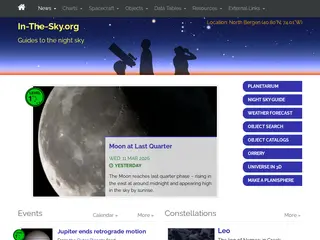
Created by Dominic Ford, In-The-Sky.org is a richly detailed astronomy portal offering real-time night sky guides, interactive planetarium tools, satellite tracking, and event calendars for celestial phenomena like eclipses, conjunctions, and meteor showers. Visitors can explore 3D solar system maps, rising and setting times for planets, deep sky object catalogs, and even printable planispheres and astrolabes, all tailored to their geographic location.
http://ben.davies.net/telescope.htm
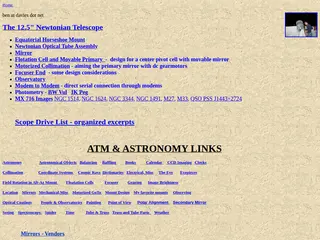
Ben Davies documents the design and construction of a 12.5-inch Newtonian telescope, covering everything from the equatorial horseshoe mount and mirror flotation cell to motorized collimation and CCD imaging. The site also includes observational work on variable stars, nebulae, galaxies, and spectroscopy, making it a rich resource for serious amateur telescope makers.
http://meteorlab.com/
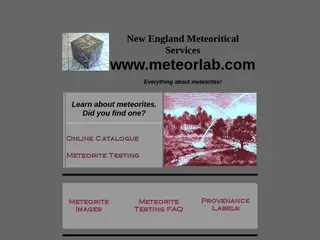
New England Meteoritical Services (meteorlab.com) is a long-running resource dedicated to everything about meteorites, including identification, appraisal, and high-resolution structural imagery through a companion site covering primary and secondary meteorite structures. The organization has been online since 1994 and served as examiner and appraiser of the historic Huss-Nininger Collection of Meteorites and Tektites, making it a notable reference for both collectors and researchers.
http://xjubier.free.fr/en/site_pages/solar_eclipses/TSE_1970_GoogleMapFull.html
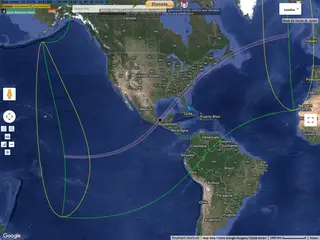
Xavier Jubier's interactive Google Map traces the path of the March 7, 1970 total solar eclipse across the USA and Mexico, offering a precise geographic visualization of the event's totality corridor. Part of a larger solar eclipse resource site, this page combines historical astronomical data with modern mapping tools to help enthusiasts and researchers explore eclipse paths.
http://thehellhole.com/
A detailed German-language educational site covering black holes and singularities, exploring topics from stellar and supermassive black holes to Hawking radiation, mathematical models, and even the theoretical dangers of black holes at CERN. The site draws a fascinating parallel between modern astrophysics and Norse mythology's concept of the Maelstrom, making complex science accessible through storytelling.
https://mrao.cam.ac.uk/surveys/snrs
Maintained by D. A. Green at the Cavendish Laboratory in Cambridge, this is a comprehensive scientific catalogue of 310 known Galactic supernova remnants, updated through October 2024. It includes detailed listings, alternate names, summary data, and links to astrophysics literature via the ADS system, making it an essential reference for researchers and astronomy enthusiasts alike.

https://nic.funet.fi/pub/astro/html/astro-uk.html
Hosted on the Finnish University and Research Network (FUNET), this is the national homepage for amateur astronomy in Finland, maintained by members of the Ursa Astronomical Association. It organizes links to Finnish astronomical clubs, research institutions, schools, planetaria, publications, and observation resources, reflecting a country with one of the highest per-capita rates of amateur astronomers in the world.