
Astronomy & Space
396 sites
https://ing.iac.es/Astronomy/telescopes/int
The official site for the Isaac Newton Telescope (INT), a major optical telescope operated by the Isaac Newton Group of Telescopes on La Palma in the Canary Islands. Visitors can explore telescope instruments, apply for observing time, access data archives, check object visibility tools, and browse publications from this working research facility.
http://gothosenterprises.com/black_holes
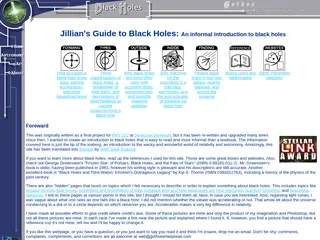
Jillian's Guide to Black Holes is an informal yet thorough educational resource originally written as a university physics project at Syracuse University, covering black hole formation, classifications, accretion disks, Hawking radiation, wormholes, and how to locate black holes across the universe. Written by Jillian in an approachable, conversational style, it stands out for its careful citations, multilingual reach (including a Basque translation), and years of ongoing updates beyond its academic origins.
http://astronomie.be/registax
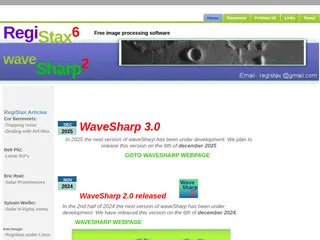
RegiStax and waveSharp are free image processing tools developed by Cor Berrevoets and an international team, designed specifically for stacking and sharpening astronomical images from AVI video files. The site hosts downloads, release notes, and articles from contributors covering lunar, solar, and planetary imaging techniques under Linux and Windows.
http://starrywonders.com/
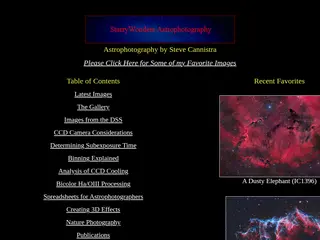
Steve Cannistra's StarryWonders is a deep-dive into astrophotography, featuring stunning CCD images of nebulae and galaxies alongside detailed technical guides on subexposure time, binning, CCD cooling analysis, and bicolor Ha/OIII processing. The site is a treasure trove for serious amateur astronomers, combining a rich image gallery with spreadsheets and tutorials that go well beyond typical hobbyist pages.

https://michielb.nl/maya/astro
Created by Michiel Bijl, this site explores Maya astronomy alongside related topics like Maya mathematics, the Maya calendar, Maya writing, and geographical orientation. It offers a fascinating intersection of ancient cultural knowledge and astronomical science, with pictures, recommended reading, and curated links.
http://kusastro.kyoto-u.ac.jp/vsnet
VSNET is an international mailing list network based at Kyoto University dedicated to real-time alerts and collaborative observation of variable stars, cataclysmic variables, novae, supernovae, and X-ray binaries. Hosting decades of light curve archives from AFOEV observations and ongoing amateur-professional collaboration campaigns, it serves as a serious citizen science hub for variable star astronomy worldwide.
https://princetonastronomy.org/
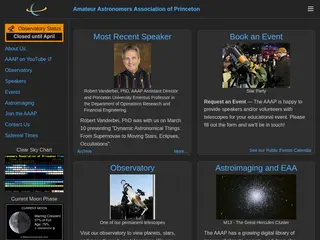
The Amateur Astronomers Association of Princeton (AAAP) is the official web presence for a New Jersey-based astronomy club bringing together hobbyists and enthusiasts to observe and explore the night sky together. Visitors can expect to find club meeting information, observing events, and resources for amateur stargazers of all experience levels.
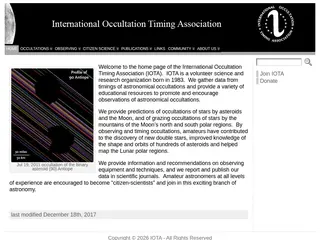
https://occultations.org/
The International Occultation Timing Association (IOTA) is a volunteer scientific organization founded in 1983 that coordinates amateur astronomers in timing astronomical occultations, including stars being blocked by asteroids and the Moon. The site offers observing guides, equipment recommendations, occultation predictions, citizen science campaigns, and published data that has contributed to real discoveries such as new double stars and improved asteroid shape models.
https://moonconnection.com/
MoonConnection.com is a comprehensive lunar reference covering moon phases, eclipses, Apollo missions, tides, and the moon's gravitational effects, complete with interactive tools and a monthly phases calendar. It also offers practical guides on fishing, hunting, and night photography by moon phase, plus companion mobile apps for tracking lunar cycles on the go.
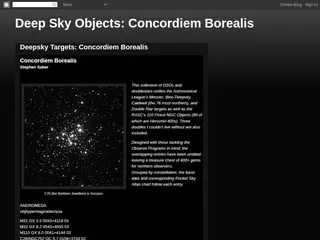
http://concordiemborealis.blogspot.com/
Stephen Saber's Concordiem Borealis is a carefully curated observing list of 400+ deep sky objects and double stars for northern hemisphere astronomers, unifying targets from the Astronomical League's Messier, Caldwell, Bino Deepsky, and Double Star programs with the RASC's Finest NGC Objects. Organized by constellation with magnitude, coordinates, and Pocket Sky Atlas chart references, it serves as a practical field companion for observers working through official observing programs.