
Astronomy & Space
396 sites

http://users.erols.com/njastro/orgs/ndsos.htm
The National Deep Sky Observers Society (NDSOS) is a worldwide amateur astronomy organization founded in 1976, dedicated to those who observe galaxies, nebulae, and star clusters. Members receive a quarterly journal called Betelgeuse, access to professional astronomical databases, and networking with fellow deep sky enthusiasts across the globe.
https://www.saao.ac.za/~wpk/astron.html
A comprehensive curated directory of astronomy links collected from mailing lists like ASTRO and HASTRO-L, covering everything from beginner stargazing tips to telescope making, satellite tracking, and the history of ancient calendars. Hosted on the South African Astronomical Observatory domain, this resource spans hundreds of links organized into detailed categories for amateur and serious astronomers alike.
http://setileague.org/
The SETI League is a nonprofit membership organization dedicated to the privatized electromagnetic search for extraterrestrial intelligence, coordinating amateur radio astronomers worldwide in the hunt for signals from other civilizations. The site offers extensive technical resources covering antennas, receivers, and software, alongside publications, press releases, and the popular "Ask Dr. SETI" column.
https://flemingastrophotography.com/
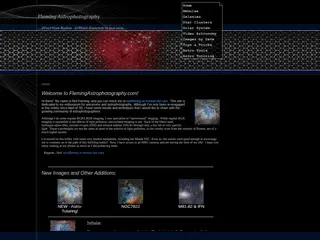
Neil Fleming's astrophotography showcase specializes in deep-sky imaging using the Meade DSI CCD camera, capturing galaxies, nebulae, and star clusters. The site highlights work done with high-end equipment including an NP-127 refractor and NJP mount, making it a compelling destination for amateur astronomers interested in CCD imaging techniques.
http://gazers.org/
The Penobscot Valley Star Gazers (PVSG) is a Maine-based astronomy club hosting monthly meetings both in-person at John Bapst High School in Bangor and via Zoom. The site offers a calendar of upcoming events, a gallery, an archive, and real-time comet tracking resources for members and stargazing enthusiasts in the region.
https://kasonline.org/
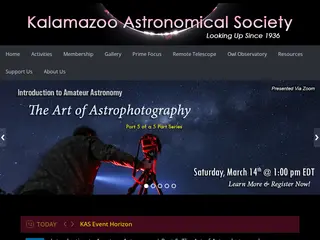
The Kalamazoo Astronomical Society (KAS) is the oldest astronomy club in Michigan, welcoming members of all skill levels from casual stargazers to experienced observers. The site offers monthly downloadable all-sky star maps, membership information, and meeting schedules for those looking to explore the night sky with a community.
http://astronomie.be/registax
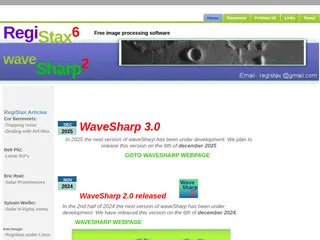
RegiStax and waveSharp are free image processing tools developed by Cor Berrevoets and an international team, designed specifically for stacking and sharpening astronomical images from AVI video files. The site hosts downloads, release notes, and articles from contributors covering lunar, solar, and planetary imaging techniques under Linux and Windows.
https://moonconnection.com/
MoonConnection.com is a comprehensive lunar reference covering moon phases, eclipses, Apollo missions, tides, and the moon's gravitational effects, complete with interactive tools and a monthly phases calendar. It also offers practical guides on fishing, hunting, and night photography by moon phase, plus companion mobile apps for tracking lunar cycles on the go.
http://cbat.eps.harvard.edu/index.html
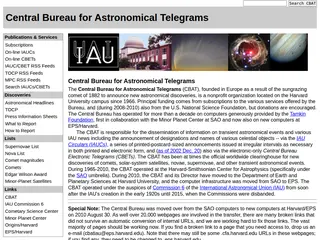
The Central Bureau for Astronomical Telegrams (CBAT), hosted at Harvard University since 1966, is the official IAU clearinghouse for announcing new astronomical discoveries including comets, novae, supernovae, and other transient celestial events. Visitors can browse online IAU Circulars, subscribe to discovery feeds, explore lists of supernovae and comets, and learn how to submit their own astronomical observations.
https://costajulio.tripod.com//cv/astronomy.htm
Julio Costa shares his lifelong passion for amateur stargazing, recounting memorable early encounters with telescopes and the purchase of a Celestron 8-inch Schmidt-Cassegrain reflector. The page includes personal photos of the moon and Jupiter with its moons, accompanied by warm, humorous writing about the joys and quirks of backyard astronomy.