
Astronomy & Space
396 sites

http://astronautica.com/owds.html
Other Worlds, Distant Suns, maintained by Garber Astronautics, is a detailed catalog of extrasolar planets featuring individual pages for dozens of star systems like 51 Pegasi, Gliese 876, and upsilon Andromedae. The site stands out for its interactive VRML 3D visualizations of extrasolar systems, observing guides for both celestial hemispheres, and curated links to leading researchers like Geoff Marcy and Jean Schneider.
http://pasnola.org/
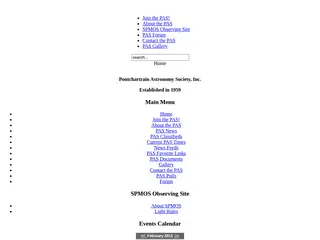
The Pontchartrain Astronomy Society, established in 1959, is a non-professional astronomy club serving Southeast Louisiana with events, observing sites, forums, and newsletters. Members gather to discuss celestial objects, attend star parties, and access resources like Clear Sky Charts and ISS sighting schedules for the New Orleans area.
https://planetary.chem.tufts.edu/Phoenix/index.html
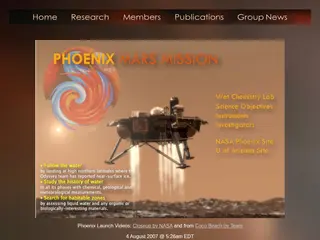
A page dedicated to NASA's Phoenix Mars Scout Mission, hosted on a Tufts University chemistry server, featuring launch videos including a close-up NASA recording and a team footage from Cocoa Beach in August 2007. It offers a glimpse into the excitement surrounding the Phoenix lander's launch, which went on to study the Martian arctic soil.
https://c2a.astrosurf.com/english/information.htm
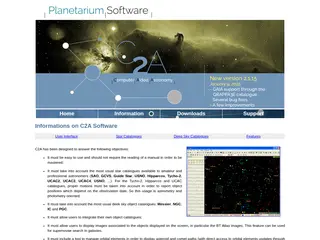
C2A is a feature-rich planetarium software created by Philippe Deverchere, designed for both amateur and professional astronomers who need precise astrometric and photometric capabilities. The site documents the software's extensive support for star catalogues including Hipparcos, Tycho-2, and UCAC4, as well as deep sky object catalogues, asteroid and comet tracking, and tools for predicting occultations and sunrise/sunset times.
http://ben.davies.net/telescope.htm
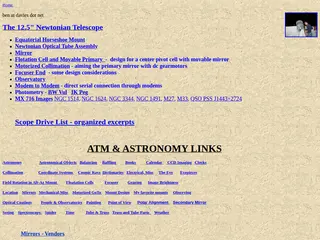
Ben Davies documents the design and construction of a 12.5-inch Newtonian telescope, covering everything from the equatorial horseshoe mount and mirror flotation cell to motorized collimation and CCD imaging. The site also includes observational work on variable stars, nebulae, galaxies, and spectroscopy, making it a rich resource for serious amateur telescope makers.
http://setileague.org/
The SETI League is a nonprofit membership organization dedicated to the privatized electromagnetic search for extraterrestrial intelligence, coordinating amateur radio astronomers worldwide in the hunt for signals from other civilizations. The site offers extensive technical resources covering antennas, receivers, and software, alongside publications, press releases, and the popular "Ask Dr. SETI" column.

https://iasindy.org/
The Indiana Astronomical Society is a membership-based club dedicated to amateur astronomy, offering monthly public lectures, access to the historic Goethe Link Observatory, dark-sky observing sites, and outreach programs for students across central Indiana. With resources ranging from a beginner Astronomy 101 crash course to star party event listings and a member collaboration site, it serves everyone from curious newcomers to seasoned sky watchers.

http://nekaal.org/doku.php
NEKAAL (Northeast Kansas Amateur Astronomers' League Inc.) is the official site for an astronomy club based in Northeast Kansas, home to the Farpoint Observatory. Visitors can find upcoming public astronomy nights, general meeting schedules, astro images, observer archives, and links to educational resources for amateur stargazers.
https://cosmotography.com/images/rc.html
R. Jay GaBany's Blackbird Observatory page details the technical setup behind his acclaimed astrophotography work, including a half-meter Ritchey-Chretien telescope, professional CCD cameras, and two remote observatory locations in New Mexico and the California Sierra Nevada. The site is a fascinating window into serious amateur deep-sky imaging, covering instrumentation, elevation advantages, and the evolution of the observatory from 2005 through 2014.
http://gothosenterprises.com/black_holes
Jillian's Guide to Black Holes is an informal yet thorough educational resource originally written as a university physics project at Syracuse University, covering black hole formation, classifications, accretion disks, Hawking radiation, wormholes, and how to locate black holes across the universe. Written by Jillian in an approachable, conversational style, it stands out for its careful citations, multilingual reach (including a Basque translation), and years of ongoing updates beyond its academic origins.