
Astronomy & Space
396 sites

https://futuretimeline.net/beyond.htm
FutureTimeline.net is an ambitious speculative reference site that maps out predictions for humanity and the universe across centuries, millennia, and beyond, covering topics from AI and nanotechnology to the far future of the cosmos. Organized as a detailed chronological timeline with supporting blogs, data trends, and artwork, it offers a sweeping vision of where science and civilization may be headed.
http://russsscope.net/staxtutorial.htm
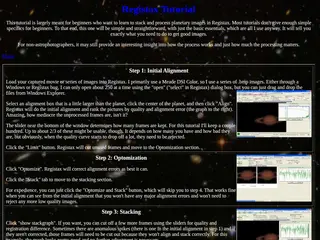
A beginner-focused step-by-step tutorial for stacking and processing planetary images using the free software Registax, written by an astrophotographer who uses a Meade DSI Color camera. The guide walks through alignment, optimization, stacking, and wavelet sharpening in plain language, making it accessible to newcomers who find other tutorials too vague.
https://centexastronomy.org/
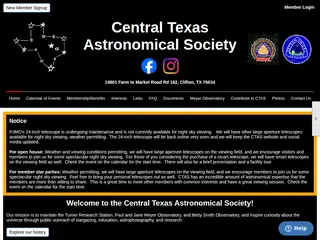
The Central Texas Astronomical Society operates Meyer Observatory and the Turner Research Station near Clifton, Texas, hosting public open houses and member star parties with large-aperture telescopes. Their mission spans stargazing outreach, astrophotography, astronomy education, and research for both newcomers and experienced observers in the Central Texas region.
https://c2a.astrosurf.com/english/information.htm
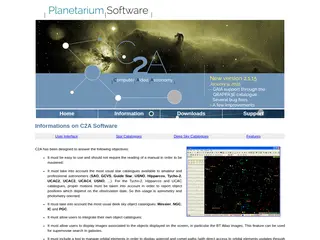
C2A is a feature-rich planetarium software created by Philippe Deverchere, designed for both amateur and professional astronomers who need precise astrometric and photometric capabilities. The site documents the software's extensive support for star catalogues including Hipparcos, Tycho-2, and UCAC4, as well as deep sky object catalogues, asteroid and comet tracking, and tools for predicting occultations and sunrise/sunset times.
http://spider.seds.org/spider/Misc/naming.html
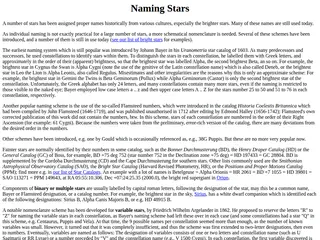
A detailed reference page from SEDS (Students for the Exploration and Development of Space) explaining how stars are named, from ancient cultural traditions to modern systematic schemes like the Bayer designation system introduced in 1603. Created by Hartmut Frommert and Christine Kronberg, the page covers Greek letter designations, star catalogs, IAU nomenclature standards, and debunks commercial 'name a star' schemes.
https://in-the-sky.org/
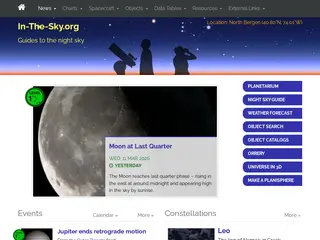
Created by Dominic Ford, In-The-Sky.org is a richly detailed astronomy portal offering real-time night sky guides, interactive planetarium tools, satellite tracking, and event calendars for celestial phenomena like eclipses, conjunctions, and meteor showers. Visitors can explore 3D solar system maps, rising and setting times for planets, deep sky object catalogs, and even printable planispheres and astrolabes, all tailored to their geographic location.
https://nineplanets.org/amateur-astronomical-observatories
The Nine Planets hosts a curated list of amateur astronomical observatories built by individual hobbyists, compiled by the site owner during research for their own backyard observatory project. Visitors will find practical inspiration and design ideas ranging from simple roll-off roof builds to more complex dome structures, all set within a broader astronomy reference site covering planets, stars, comets, and equipment guides.
https://astro.uni-bonn.de/~pbrosche/astoria.html
Hosted at the University of Bonn's Argelander Institute for Astronomy, this long-running site by Wolfgang R. Dick serves as a curated hub for the history of astronomy, linking to resources on history of science, notable events like the Simon Marius symposium, and the Working Group for the History of Astronomy. Created in 1995 and maintained for decades, it bridges academic astronomy with historical scholarship in both English and German.
http://c14isawesome.blogspot.com/
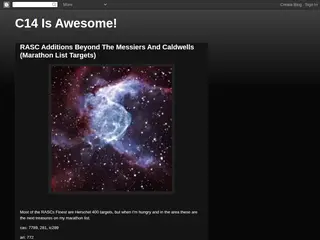
Stephen Saber, an amateur astronomer, shares deep-sky observing lists, lunar phenomena like Saber's Beads, and stargazing tips on this enthusiast blog. Catalogued targets from the Messier, Caldwell, RASC, and Herschel 400 lists make it a practical resource for marathon observers hunting NGC objects.
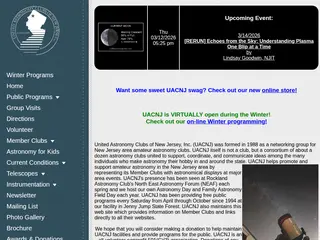
http://uacnj.org/
The United Astronomy Clubs of New Jersey (UACNJ) operates multiple observatories at Jenny Jump State Forest and hosts regular public stargazing nights, meteor shower events, and astronomy programs for all ages. The site serves as a hub for member clubs, event scheduling, live sky cameras, newsletter archives, and donation drives for new observatory construction.