
Astronomy & Space
396 sites
https://gaac.us/
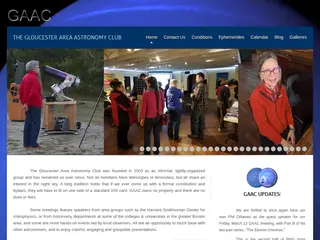
The Gloucester Area Astronomy Club (GAAC) is a casual, no-dues astronomy group founded in 2003 that meets monthly at the Lanesville Community Center in Gloucester, Massachusetts. The site features member photo galleries, ephemerides, aurora alerts, object rise/set times, and a calendar of events for anyone curious about the night sky.
https://www.aosny.org/AOSLinksIndex.htm
The Amateur Observers' Society of New York maintains this comprehensive links directory covering astronomical magazines, podcasts, space agencies, comet and meteor shower resources, astronomy apps, dealers, and member websites. A well-organized gateway for amateur astronomers in the New York area, the page also highlights member-exclusive discounts on publications like Sky and Telescope and Astronomy Magazine.
http://dibonsmith.com/graphics.htm
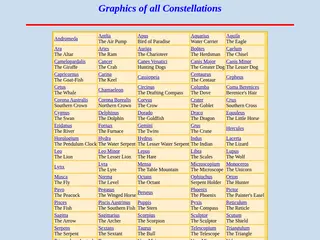
Created by Richard Dibon-Smith, this site provides graphics and reference information for all 88 officially recognized constellations, from Andromeda to Vulpecula. Each constellation gets its own dedicated page, making it a handy visual reference for amateur astronomers and sky-watchers.
http://catawbasky.org/
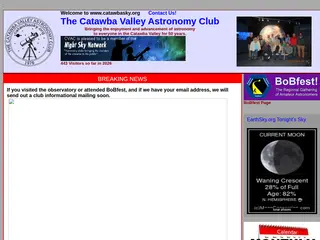
The Catawba Valley Astronomy Club (CVAC) has been bringing amateur astronomy to North Carolina's Catawba Valley for 50 years, operating the Lucile Miller Observatory and hosting public stargazing events at parks, schools, and local venues. The site serves as the club's hub for event schedules, membership applications, officer listings, and clear sky charts for observers in the region.
https://pk3.org/Astro/index.htm?k3ccdtools.htm=
Peter Katreniak's astronomy page covers CCD imaging and observations of planets, the Moon, the Sun, eclipses, and deep-sky objects. A hobbyist astronomer's showcase featuring telescope photography and tools like K3CCDTools, making it a great find for amateur astrophotographers.
https://solarviews.com/eng/mars.htm
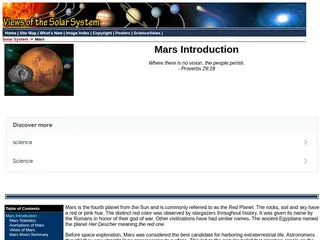
Calvin J. Hamilton's comprehensive Mars reference page covers everything from the planet's geology and atmosphere to its moons, polar regions, and exploration missions like Viking, Pathfinder, and the Mars Rovers. Packed with images, animations, 3D galleries, and scientific articles, it serves as a deep-dive educational hub for anyone fascinated by the Red Planet.
http://skytour.homestead.com/
Wes's astronomy hub, active since 1995, offers a rich collection of observing logs, sketch galleries, comet documentation, meteor shower reports, and essays drawn from decades of visual astronomy with a 10-inch Dobsonian telescope. Highlights include extensive Oregon Star Party trip reports spanning nearly two decades, comet scrapbooks for Hale-Bopp and Hyakutake, and thoughtful amateur astronomy essays that range from beginner telescope guides to celestial measurement explanations.
https://mo-www.cfa.harvard.edu/OWN/about.html
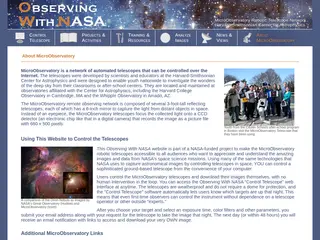
MicroObservatory is an internet-controlled robotic telescope network developed by scientists and educators at the Harvard-Smithsonian Center for Astrophysics, designed to let students across the country capture real deep-sky images from their classrooms. Visitors can control telescopes remotely, analyze astronomical images, and access educational projects tied to NASA's educational mission.
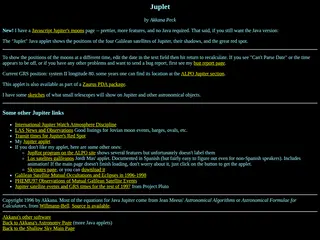
https://shallowsky.com/jupiter.html
Akkana Peck's Juplet page offers a Java applet and JavaScript tool for tracking the positions of Jupiter's four Galilean moons, their shadows, and the Great Red Spot in real time. A labor of love rooted in real astronomical calculations from Jean Meeus' algorithms, the page also includes telescope sketches, links to Jupiter observation resources, and satellite event data.
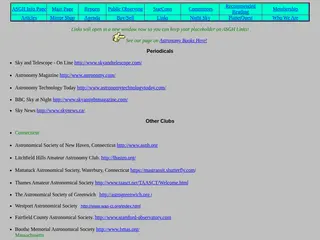
https://asgh.org/legacy/links.htm
The Astronomical Society of Greenwich Hills (ASGH) maintains this curated links page connecting amateur astronomers to periodicals, regional astronomy clubs, observatories, equipment suppliers, and NASA educational resources. A thorough reference hub for stargazers in Connecticut and New England, it lists dozens of affiliated clubs and organizations alongside tools for both hobbyists and kids.