
Biology
79 sites
https://kaskakokos.neocities.org/
Kaskakokos is a Spanish-language personal site from Cantabria featuring a section dedicated to local plant life, alongside writings and projects by the creator. The 'Plantas de Cantabria' section suggests a focus on regional flora, making it a charming mix of nature documentation and personal creative output.
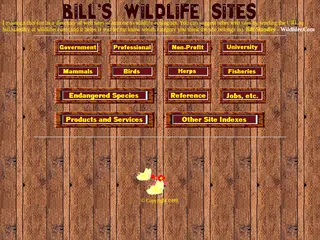
http://wildlifer.com/wildlifesites/index.html
Bill Standley's curated directory of internet resources for wildlife ecologists, organized into categories covering federal and state organizations, professional and non-profit groups, universities, and taxa such as mammals, birds, amphibians, and reptiles. The site also indexes resources for endangered species, fisheries, aquatic ecology, jobs, and wildlife-related products like telemetry equipment and optics.
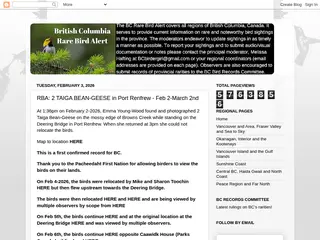
https://bcbirdalert.blogspot.com/
BC Rare Bird Alert is a community birding blog tracking rare and unusual bird sightings across British Columbia, Canada, with detailed location reports, maps, and observer notes. Each post documents a specific rare species encounter, making it an invaluable real-time resource for birdwatchers and ornithology enthusiasts in the Pacific Northwest.
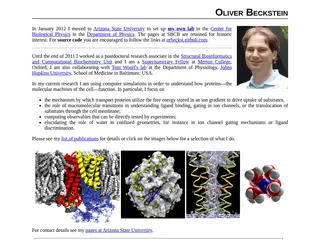
https://sbcb.bioch.ox.ac.uk/users/oliver/home.html
Oliver Beckstein's academic homepage showcases his computational biochemistry research at the intersection of physics and biology, covering topics like ion channel gating, membrane transport proteins, and molecular simulations. Hosted at the University of Oxford's Structural Bioinformatics and Computational Biochemistry Unit, the site links to publications, software, and his lab at Arizona State University's Center for Biological Physics.
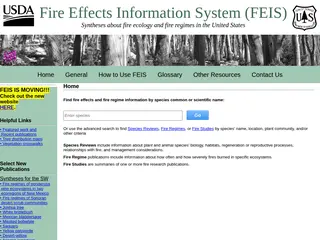
https://feis-crs.org/feis
The Fire Effects Information System (FEIS) is a U.S. Forest Service database providing detailed scientific syntheses on fire ecology, fire regimes, and the effects of fire on plant and animal species across the United States. Visitors can explore species profiles, vegetation crosswalks, tree distribution maps, and research publications covering ecosystems from ponderosa pine forests to Sonoran desert scrub communities.
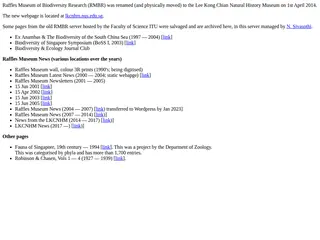
http://rmbr.nus.edu.sg/
The archived web presence of the Raffles Museum of Biodiversity Research (RMBR) at the National University of Singapore, now preserved after the museum was renamed and relocated as the Lee Kong Chian Natural History Museum in 2014. Visitors can explore decades of biodiversity research, newsletters, symposium records, and an extensive 19th-century fauna of Singapore catalog with over 1,700 taxonomic entries.
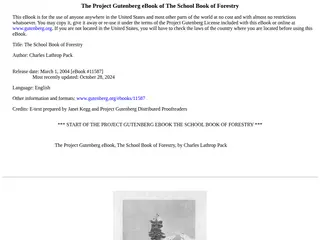
https://gutenberg.org/cache/epub/11587/pg11587-images.html
A digitized 1922 educational text by Charles Lathrop Pack, President of the American Tree Association, covering all aspects of forestry from how trees grow to national forest policy and the dangers of fire and disease. Hosted on Project Gutenberg, this freely available ebook spans 18 chapters and includes period photographs of forests, rangers, and fire damage, making it a fascinating historical resource on early American conservation thought.
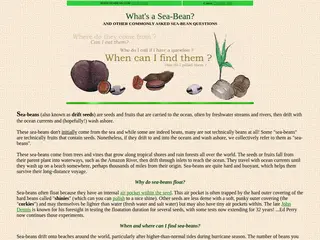
https://seabean.com/what.asp
Seabean.com is a dedicated reference site exploring the fascinating world of sea-beans and drift seeds, those tropical seeds and fruits that travel ocean currents for thousands of miles before washing ashore. Visitors can learn how sea-beans float, where they originate, and how to identify specific species like Tropical Almond and Hog Plum.
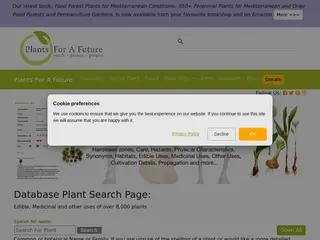
https://pfaf.org/user/Default.aspx
Plants For A Future (PFAF) is a searchable database of over 8,000 plants catalogued by their edible, medicinal, and other practical uses, making it an essential reference for permaculture enthusiasts and herbalists alike. The site covers topics ranging from food forests and carbon farming to rare and unusual perennial plants, with browsable indexes and habitat guides built up over decades by a UK-registered charity.
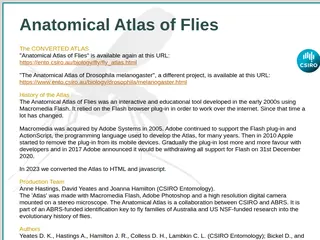
https://ento.csiro.au/biology/fly/fly.html
Developed by CSIRO Entomology researchers, this anatomical atlas provides detailed visual and educational reference material covering the morphology of flies (Diptera), originally built in Flash and converted to HTML in 2023. A collaboration between CSIRO and ABRS, it includes identification keys and anatomical glossaries for fly families found in Australia, making it a valuable tool for entomologists and biology students alike.