
Biology
79 sites
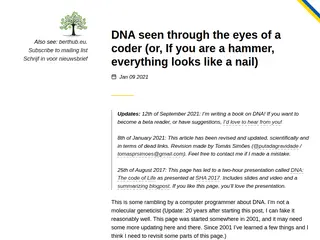
https://berthub.eu/articles/posts/amazing-dna
Bert Hubert's long-running article explains DNA biology through the lens of a computer programmer, drawing analogies between genetic code and software concepts like error correction, compression, and the halting problem. Originally written in 2001 and revised multiple times since, it became popular enough to spawn a two-hour conference presentation and an upcoming book.
https://xeno-canto.org/
Xeno-canto is a massive community-driven database of wildlife sound recordings from around the world, covering birds, frogs, mammals, bats, and more, browsable by region or taxonomy. Launched in 2005, it serves researchers, birders, and curious listeners alike with tens of thousands of freely downloadable recordings backed by an open API and active community forum.
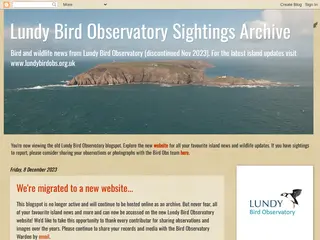
http://lundybirds.blogspot.com/
The Lundy Bird Observatory Sightings Archive is a long-running blog documenting bird and wildlife observations from Lundy Island, now preserved as a historical archive after migrating to a new site in late 2023. Years of detailed sighting reports, species updates, and passage records make it a rich resource for birdwatchers and naturalists interested in this unique Atlantic island.
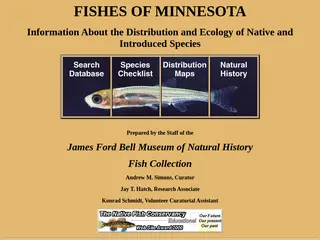
https://academics.cehd.umn.edu/hatch/default.htm
Produced by the staff of the James Ford Bell Museum of Natural History at the University of Minnesota, this reference site covers the distribution and ecology of native and introduced fish species found in Minnesota. Curated by Andrew M. Simons and Jay T. Hatch, it serves as both a scientific resource and a public education tool tied to the museum's fish collection.
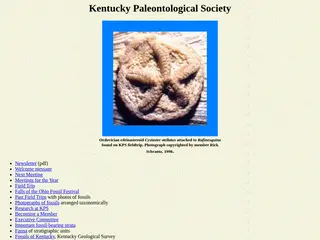
https://uky.edu/OtherOrgs/KPS
The Kentucky Paleontological Society maintains this hub for fossil enthusiasts in the Bluegrass State, featuring field trip reports, taxonomic fossil photo galleries, and an impressive library of digitized historical geology texts dating back to the 1860s. From Ordovician trilobites to tetrapod trackways, the site covers Kentucky's rich fossil record with resources for both amateur collectors and researchers.
https://content.lib.washington.edu/salmonweb
Curated by the University of Washington Libraries Special Collections Division, this digital archive spans 1890 to 1961 and brings together photographs, documents, and original materials tracing the history of salmon fishing and the roots of the Pacific Northwest salmon crisis. Visitors can browse topics ranging from Native American fishing practices and salmon canneries to hatcheries and the Columbia River salmon industry.
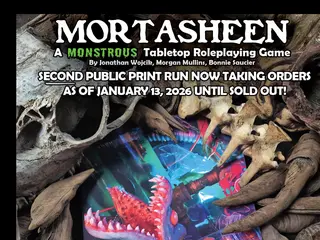
https://bogleech.com/
Bogleech is Jonathan Wojcik's long-running labor of love covering creature design reviews, bizarre biology, weird fiction, and year-round Halloween horror since 2001. Visitors will find deep-dive reviews of Pokemon and Digimon monsters, original tabletop RPG content including the Mortasheen bestiary, Halloween finds, and a sprawling archive of creature-focused writing spanning decades.
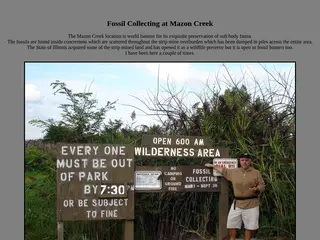
https://nautiloid.net/fossils/sites/mazon/mazon.html
A firsthand account of fossil hunting at the Mazon Creek site in Illinois, one of the world's most celebrated locations for soft-body fauna preservation found inside concretions. The author shares photos, practical tips on finding nodules, and personal observations from multiple visits to this unique strip-mine-turned-wildlife-preserve.
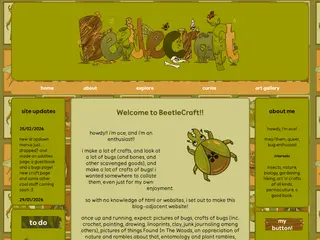
https://beetlecraft.neocities.org/
Beetlecraft is a charming personal site by Ace, a self-described bug enthusiast who shares their love of insects, nature, bone mounting, and art through a whimsical hand-crafted aesthetic. Visitors can explore a bugs page featuring finds like the Duckbilled Beetle, an art gallery, a curios section, and a blog with guides to activities like bone mounting.

https://bugland.neocities.org/
Bugland is a Neocities site dedicated to insects and bugs, presenting a single striking image that hints at a nature-focused personal project. The minimal content suggests an early-stage site built around an enthusiasm for entomology and the tiny creatures of the natural world.