
Chemistry
8 sites
https://theodoregray.com/PeriodicTable
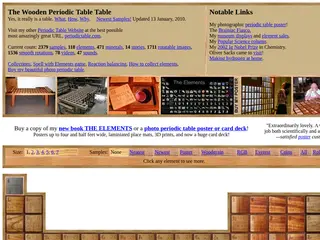
Theodore Gray's landmark site documents his handcrafted wooden periodic table desk, which contains actual samples of all 118 chemical elements, with thousands of photos, rotatable 3D images, videos, and detailed information for each element. With over 2,379 samples, 471 minerals, and a wealth of interactive features including an element-spelling game and reaction balancing, this is one of the most thorough and visually stunning chemistry reference sites on the web.
https://jmol.sourceforge.net/
Jmol is a free, open-source Java application and HTML5 tool for visualizing chemical structures in interactive 3D, supporting molecules, crystals, biomolecules, and materials. The project offers downloadable binaries, extensive scripting documentation, demos, and a community mailing list, making it a go-to resource for chemistry education and research.
https://chemguide.co.uk/index.html
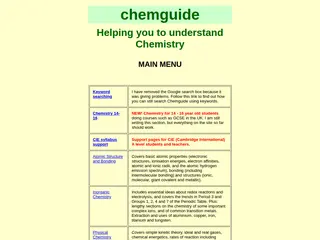
Chemguide, created by Jim Clark, is a comprehensive chemistry reference site aimed at helping students aged 14 through A-level understand topics ranging from atomic structure and bonding to organic reaction mechanisms and physical chemistry. Covering major UK exam syllabuses including GCSE, CIE Cambridge International, and Edexcel, it serves as an authoritative free study aid with deep topic coverage across all major chemistry disciplines.
https://ptable.com/
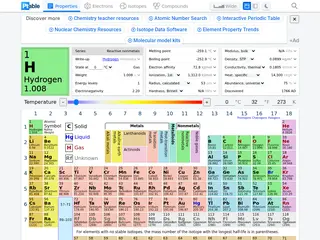
Ptable is a richly interactive periodic table created by Michael Dayah, offering property trend visualization, 3D orbital diagrams, isotope data, and compound mixing tools for all 118 elements. Available in dozens of languages and regularly updated, it serves as a go-to reference for students, educators, and chemistry enthusiasts alike.
http://ukesca.org/
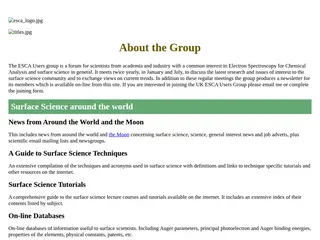
The UK ESCA Users Group is a professional forum connecting scientists from academia and industry around Electron Spectroscopy for Chemical Analysis and surface science, meeting twice yearly and publishing an online newsletter. The site offers an extensive guide to surface science techniques and acronyms, tutorials, online databases of binding energies and elemental properties, and a global directory of surface science laboratories.
http://tudorchemicals.co.uk/
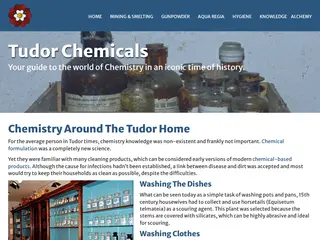
Tudor Chemicals explores the surprisingly rich world of chemistry as it existed in Tudor-era England, covering topics like homemade cleaning agents, gunpowder, alchemy, and aqua regia. Visitors curious about historical science will find accessible explanations of how ordinary households used chemical processes long before the science was formally understood.
https://electrochemeisbasics.blogspot.com/
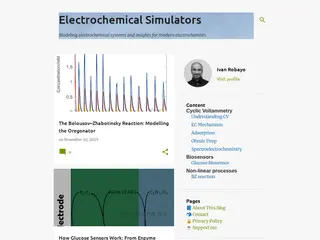
Ivan Robayo's technical blog explores electrochemical systems through simulation and modeling, covering topics like cyclic voltammetry, biosensors, ohmic resistance, and the Belousov-Zhabotinsky reaction. Posts combine physical chemistry theory with computational tools like R, deSolve, and Shiny to make complex electrochemical concepts accessible and interactive.
http://fbdd-lit.blogspot.com/
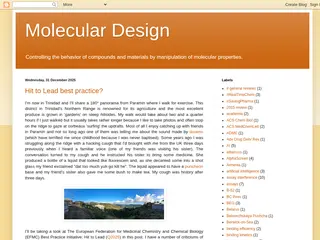
Molecular Design is a scientific blog exploring the manipulation of molecular properties to control the behavior of compounds and materials, written by contributors including Mel Peter Kenny. Posts blend technical drug discovery topics like Hit to Lead optimization with personal observations from Trinidad and the UK, giving the site a distinctive voice that mixes rigorous science with vivid storytelling.