
Encyclopedias & FAQs
109 sites
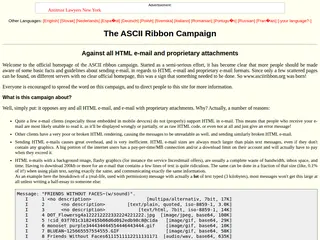
http://asciiribbon.org/
The official home of the ASCII Ribbon Campaign, an advocacy movement urging internet users to avoid HTML email and proprietary file attachments in favor of plain text. The site explains the technical and practical reasons behind the campaign, offers multilingual resources, and provides badge graphics for supporters to display on their own sites.
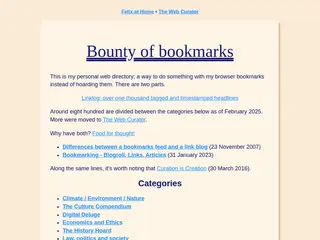
https://felix.plesoianu.ro/links/index.html
Felix's personal web directory collects over a thousand tagged and timestamped bookmarks spanning topics from climate and history to science, technology, and culture. Organized into themed categories like 'The History Hoard' and 'The Sci-Tech Stash,' it functions as a curated link library with highlighted reads on AI, meritocracy, and media criticism.
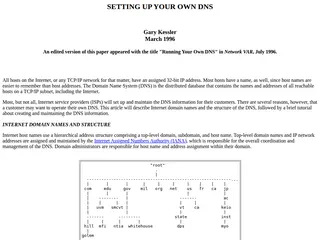
https://garykessler.net/library/dns.html
Gary Kessler's 1996 technical article walks readers through setting up and maintaining their own DNS server on a TCP/IP network, covering domain name structure, resource records, and BIND configuration. Originally published in Network VAR magazine, it remains a solid historical reference for understanding how the Domain Name System works at an administrative level.
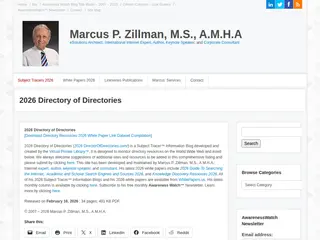
https://2025directoryofdirectories.com/
Created and maintained by Marcus P. Zillman, this is a curated meta-directory that organizes and links to other directories across the web, serving as a one-stop resource for finding organized collections of links on virtually any topic. A classic old-web reference tool for researchers and web explorers who want to navigate the internet through structured, human-curated indexes.
http://gor.net/encyclopedia.html
A bare-bones page from gor.net serving what appears to be an encyclopedia resource, with virtually no visible content beyond a single image. The site's minimal structure makes it difficult to assess its original purpose or scope.
https://dlib.org/dlib/april05/hammond/04hammond.html
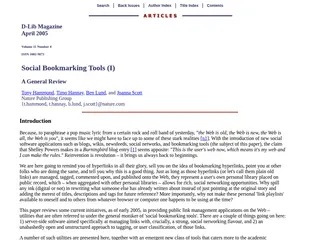
Published in D-Lib Magazine in April 2005, this academic article by Tony Hammond and colleagues at Nature Publishing Group provides a comprehensive review of social bookmarking tools, covering platforms like del.icio.us, tagging systems, RSS feeds, and the emerging concept of the social web. It offers a detailed look at how user-driven bookmarking and tagging were reshaping information management on the early Web, making it a fascinating historical snapshot of Web 2.0 in its infancy.
https://webcurios.co.uk/
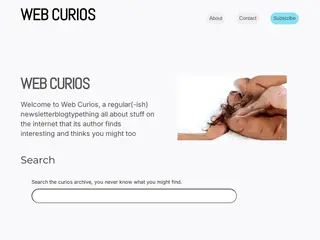
Web Curios is a long-running newsletter-style blog curating the most interesting, strange, and compelling corners of the internet, published on a regular weekly schedule. Each edition is a sprawling, opinionated tour through web oddities, digital culture, and current events, written with a distinctly sardonic British voice.
https://zytrax.com/books/dns/ch8/cname.html
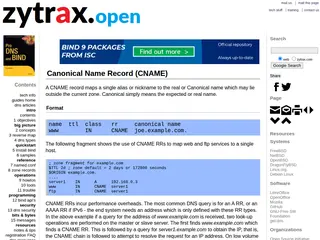
ZyTrax hosts a comprehensive technical reference guide covering DNS records, with this chapter dedicated to CNAME (Canonical Name Record) syntax, usage, and zone file examples. Part of a broader open guide by Ron Aitchison, the site spans DNS, LDAP, networking protocols, SSL/TLS, and much more, making it a deep technical resource for sysadmins and network engineers.
https://softwarefreedom.org/resources/2008/foss-primer.html
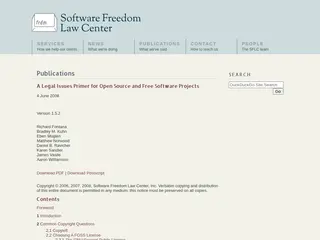
Published by the Software Freedom Law Center, this comprehensive legal primer covers copyright, licensing, trademarks, and organizational issues specifically for free and open source software projects. Written by prominent FOSS legal experts including Eben Moglen and Bradley Kuhn, it walks developers through choosing licenses like the GPL, handling copyright enforcement, and structuring their organizations.
https://rlcolem.tripod.com/index-cool.html
A sprawling personal link directory by rlcolem covering dozens of categories including health, government, entertainment, news, music, and museums. Built in classic late-90s tripod style, it curates hundreds of external links organized into neat topic sections, serving as a one-stop gateway to the early web.