
History
162 sites
http://wimble.outlandsheralds.org/
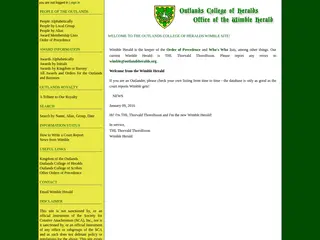
The Outlands College of Heralds Wimble Herald site maintains the Order of Precedence and Who's Who records for members of the Society for Creative Anachronism's Kingdom of the Outlands. Visitors can search for people by name, alias, or local group, browse award membership lists, and find information about awards given across reigns and baronies.
http://blancheparry.co.uk/
A detailed research site dedicated to Blanche Parry, chief gentlewoman to Queen Elizabeth I, created by historian Ruth E. Richardson. Visitors will find biographical research, articles on Herefordshire churches and abbeys, Welsh ancestry tracing, and investigations into topics like Iron Age hillforts, medieval drama, and even who killed Richard III.
https://coloniallords.com/
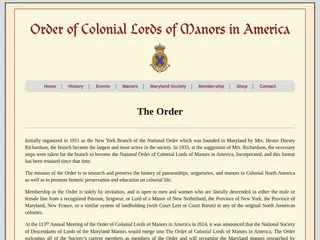
The Order of Colonial Lords of Manors in America is a hereditary lineage society founded in 1911, dedicated to researching and preserving the history of patroonships, seigneuries, and manors in Colonial North America. Membership is by invitation only, open to descendants of recognized Patroons, Seigneurs, or Lords of Manors from New Netherland, colonial New York, Maryland, and New France.
https://effigiesandbrasses.com/
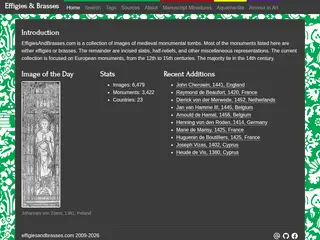
EffigiesAndBrasses.com is a vast image database cataloguing over 6,400 medieval monumental tombs, including effigies, brasses, incised slabs, and half-reliefs from 23 European countries spanning the 12th to 15th centuries. With nearly 3,500 monuments indexed and organized by searchable tags and sources, this is an exceptional reference for researchers and enthusiasts of medieval history, heraldry, and funerary art.
https://tenochtitlan.thomaskole.nl/
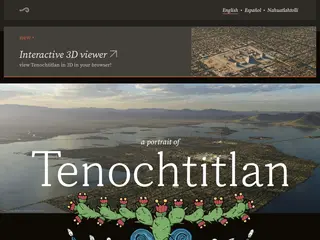
Thomas Kole's meticulously researched 3D reconstruction brings the Aztec capital of Tenochtitlan back to life as it appeared in 1518, using historical and archaeological sources rendered in Blender. The site features an interactive 3D viewer, stunning photorealistic renders of temples, canals, and city districts, and is available in English, Spanish, and Nahuatl.
http://kidshow.dcmemories.com/bozopt4.html
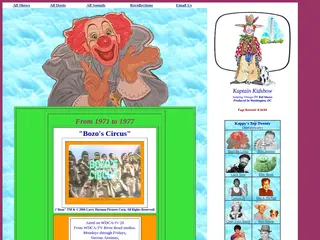
A detailed archive dedicated to the history of locally-produced children's television in Washington DC, with this page focusing on the Bozo the Clown show that aired on WDCA-TV 20 from 1971 to 1977. Featuring donated photos, precise broadcast schedules, and profiles of hosts like Tony Alexi and Dick Dyszel, it offers a rich nostalgic record of regional kidshow TV history.
https://obscurebattles.blogspot.com/2013/12/elchingen-1805.html
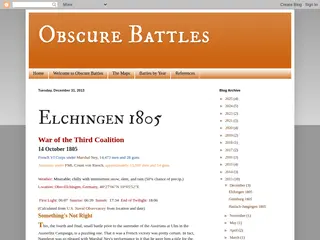
Obscure Battles is Jeff Berry's detailed blog dedicated to analyzing lesser-known military engagements throughout history, with each post reconstructing a specific battle using troop counts, weather conditions, geographic coordinates, and tactical analysis. The entry on Elchingen 1805 is a great example of the depth on offer, examining why the French under Marshal Ney triumphed despite the Austrians holding seemingly superior positions during Napoleon's Austerlitz Campaign.
http://cyndislist.blogspot.com/
Cyndi Ingle's companion blog to the legendary CyndisList.com, a free categorized index of genealogical resources on the Internet that has been running since 1996. Here she shares tips, advice, personal reflections, and updates about the main directory, making it a must-visit for anyone tracing family history online.
https://ancient-greek.net/
Created by Marvin J., ancient-greek.net is a growing reference hub dedicated to the Ancient Greek language and culture, spanning from the Classical Period through the Byzantine era. Visitors will find free audiobooks, original translations, vocabulary files, grammar resources, and even an Ancient Greek Wordle, making it a surprisingly rich destination for language learners and history enthusiasts alike.
https://wtj.com/portal
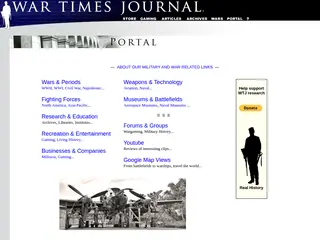
War Times Journal Portal is a curated directory of military and war-related links spanning conflicts from the Napoleonic era through WWII, organized into categories like weapons, museums, research archives, and gaming. It serves as a gateway to resources on military history, living history groups, battlefields, and wargaming communities, making it a useful hub for history enthusiasts and researchers alike.