
Mathematics
59 sites
https://nsml.org/
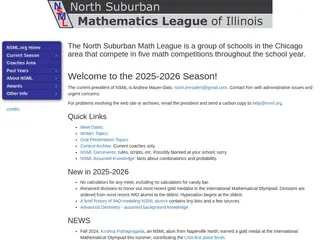
The North Suburban Math League (NSML) organizes competitive math meets for Chicago-area high schools, with five competitions held throughout the school year. The site provides contest archives, meet schedules, written and oral topic lists, coach resources, and a history of NSML alumni who have earned medals at the International Mathematical Olympiad.
https://onlinestatbook.com/rvls.html
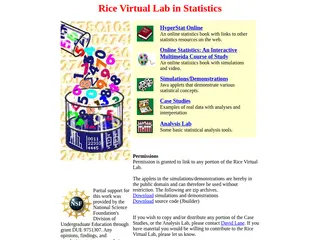
The Rice Virtual Lab in Statistics (RVLS), created by David Lane at Rice University, offers a comprehensive suite of free web-based tools for learning and teaching statistics, including an interactive online textbook, Java simulations, real-world case studies, and an analysis lab. Supported by the National Science Foundation and recognized by multiple educational organizations, it covers topics from basic descriptive statistics to ANOVA and regression.
https://knotplot.com/
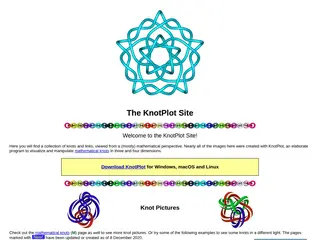
Created by Robert G. Scharein, the KnotPlot Site is a visually stunning exploration of mathematical knot theory, featuring hundreds of images and animations generated by the KnotPlot software for Windows, macOS, and Linux. Visitors can browse galleries of torus knots, Celtic knots, hyperbolic knots, Brunnian links, and fractal structures, as well as download the KnotPlot program itself to visualize and manipulate knots in three and four dimensions.
http://aleph0.clarku.edu/~djoyce/java/compass
David E. Joyce of Clark University presents a detailed mathematical exploration of compass-only geometric constructions, proving that a straightedge is unnecessary for any Euclidean construction. The site covers circle inversion, stereographic projection, inversive geometry, and involutory quandles, drawing on the historical work of Mohr and Mascheroni.
https://gogeometry.com/
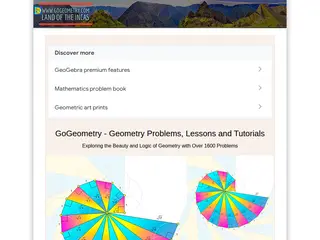
GoGeometry, created by Antonio Gutierrez, offers over 1600 illustrated geometry problems alongside interactive lessons and tutorials suited for both students and teachers. The site blends mathematical rigor with cultural touches, weaving in references to Incan heritage, Machu Picchu, and the golden ratio to make geometry visually engaging and globally inspired.
http://finitegeometry.org/sc/16/quiltgeometry.html
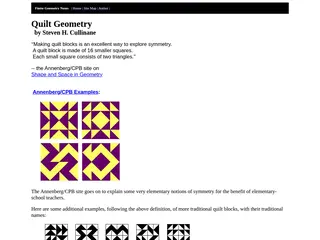
Created by Steven H. Cullinane, this page explores the mathematical geometry underlying quilt block design, connecting symmetry theory to traditional patchwork patterns. It organizes curated resources across three difficulty levels, from elementary classroom guides to advanced topics like block designs in art and mathematics.
https://cut-the-knot.org/
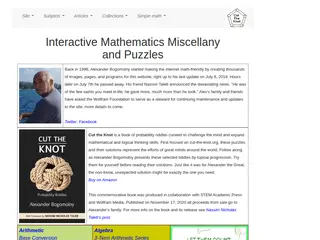
Created by Alexander Bogomolny starting in 1996, Cut the Knot is a massive encyclopedic collection of interactive mathematics covering geometry, algebra, probability, puzzles, proofs, and much more, built over decades until his passing in 2018. With thousands of pages, interactive Java applets, Olympiad problems, and articles spanning all levels of math, it stands as one of the most beloved and comprehensive math resources ever built on the early web.
https://mathcs.clarku.edu/%7Edjoyce/hilbert/toc.html
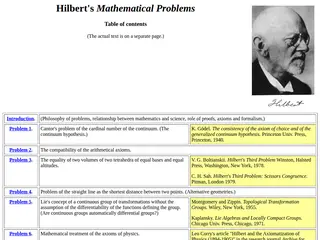
Created by David E. Joyce of Clark University, this site presents the full text of David Hilbert's famous 1900 lecture outlining 23 unsolved mathematical problems that shaped 20th-century mathematics. Each problem links to its own dedicated page with references to key solutions and related works, making it an invaluable reference for anyone studying the history and foundations of mathematics.
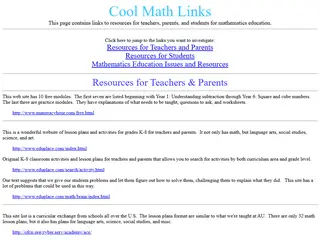
https://www.andrews.edu/~burton/mathlinks/coolmathlinks.htm
A curated collection of mathematics education links compiled at Andrews University, organized into sections for teachers, parents, and students across K-12 grade levels. The directory covers lesson plans, interactive activities, problem-solving resources, and NCTM-aligned curriculum materials from across the early web.
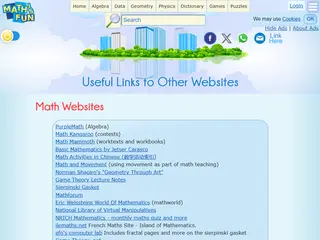
https://www.mathsisfun.com/links/external.html
A curated collection of external math links from MathIsFun, organized into math websites, fun puzzle sites, and schools, covering everything from algebra and geometry to game theory and Pi. Created by Rod Pierce, this page serves as a springboard to some of the web's best math resources for students, teachers, and curious minds alike.