
Mathematics
59 sites
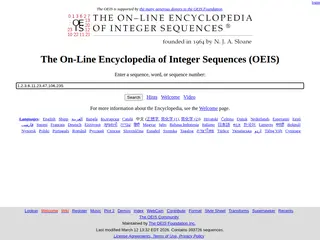
https://oeis.org/
The OEIS is a massive searchable database of over 393,000 integer sequences, maintained by the OEIS Foundation and originally created by mathematician Neil Sloane. Researchers, students, and math enthusiasts can look up sequences by entering numbers to identify patterns, explore combinatorics, and discover connections across mathematical disciplines.
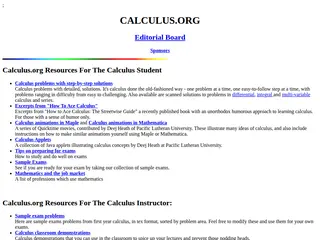
http://math.ucdavis.edu/~calculus
Calculus.org is a comprehensive educational hub hosted by UC Davis, offering step-by-step calculus problems, Java applets, Maple and Mathematica animations, and sample exams for both students and instructors. The site covers differential, integral, and multivariable calculus with resources ranging from humorous beginner guides to actuarial review problems, making it a well-rounded reference for anyone tackling the subject.
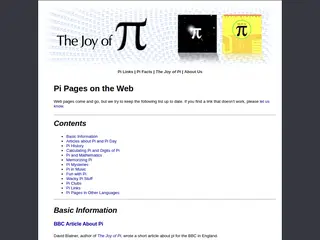
http://joyofpi.com/pilinks.html
A comprehensive link directory dedicated entirely to pi, curated by David Blatner, author of 'The Joy of Pi,' covering everything from basic pi facts and digit downloads to pi music, pi history, and Pi Day celebrations. Visitors will find hundreds of categorized links spanning memorizing pi, calculating digits, pi mysteries, and even wacky pi fun, making it a go-to hub for pi enthusiasts of all levels.
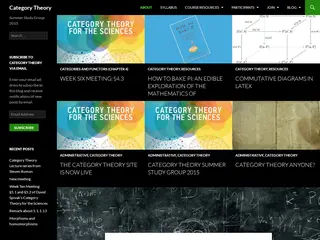
http://cat.boffosocko.com/
A collaborative study group blog documenting UCLA Extension's 2015 Category Theory course led by Professor Michael Miller, covering abstract algebra, functors, and related mathematical structures. Participants followed a structured syllabus across multiple chapters, sharing notes, resources, LaTeX diagrams, and meeting summaries over the summer term.
https://taygeta.com/random/gaussian.html
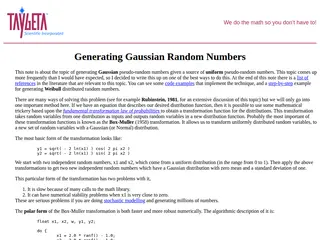
Taygeta Scientific Inc. presents a technical reference on generating Gaussian pseudo-random numbers using the Box-Muller transformation, written by Dr. Everett (Skip) F. Carter Jr. The page includes code examples, a step-by-step Weibull distribution walkthrough, and an academic reference list covering stochastic modelling and Monte Carlo methods.
https://www2.math.uconn.edu/~glaz/Fun_Math_Links/index.html
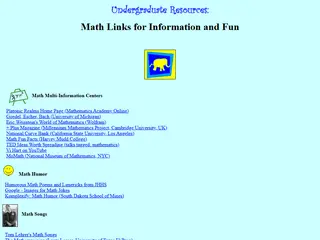
Maintained by University of Connecticut math professor Sarah Glaz, this curated link collection gathers hundreds of resources covering math humor, mathematical poetry, math in film and theater, interactive geometry, famous problems, and career guidance. It serves as a rich undergraduate reference bridging serious mathematics with its cultural and creative dimensions.
http://finitegeometry.org/sc/16/quiltgeometry.html
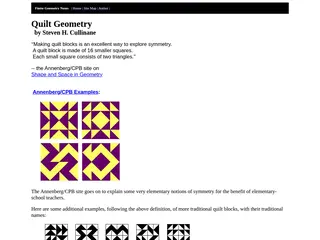
Created by Steven H. Cullinane, this page explores the mathematical geometry underlying quilt block design, connecting symmetry theory to traditional patchwork patterns. It organizes curated resources across three difficulty levels, from elementary classroom guides to advanced topics like block designs in art and mathematics.
https://kennethfalconer.github.io/
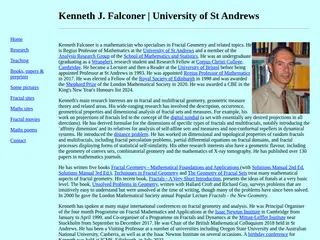
Kenneth Falconer is a Regius Professor of Mathematics at the University of St Andrews whose personal academic page covers his pioneering work in fractal geometry, geometric measure theory, and multifractal analysis. Visitors will find links to his books and preprints, fractal movie resources, maths poems, and even a note about his impressive record completing 36 LDWA hundred-mile walks.
https://dominiccook.xyz/
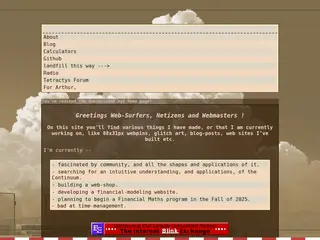
Dominic Cook's personal site collects his explorations in mathematics, number theory, measure theory, and speculative metaphysics alongside creative web projects like 88x31 webpins, glitch art, and calculators. The mix of rigorous mathematical writing and old-web aesthetics makes it a quirky, intellectually curious corner of the indie web.
http://euclid.psych.yorku.ca/SCS/Gallery
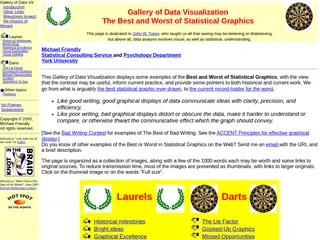
Hosted at York University, the Gallery of Data Visualization is a reference collection showcasing classic and contemporary examples of statistical graphics and chart design. It serves as an educational resource for students and researchers interested in how data can be effectively communicated through visual means.