
Mathematics
59 sites
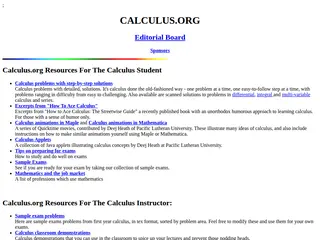
http://math.ucdavis.edu/~calculus
Calculus.org is a comprehensive educational hub hosted by UC Davis, offering step-by-step calculus problems, Java applets, Maple and Mathematica animations, and sample exams for both students and instructors. The site covers differential, integral, and multivariable calculus with resources ranging from humorous beginner guides to actuarial review problems, making it a well-rounded reference for anyone tackling the subject.
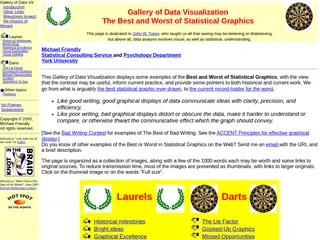
http://euclid.psych.yorku.ca/SCS/Gallery
Hosted at York University, the Gallery of Data Visualization is a reference collection showcasing classic and contemporary examples of statistical graphics and chart design. It serves as an educational resource for students and researchers interested in how data can be effectively communicated through visual means.
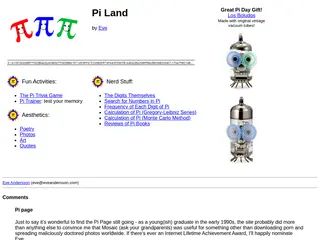
http://eveandersson.com/pi
Pi Land is Eve Andersson's comprehensive tribute to the mathematical constant pi, featuring trivia games, a memory trainer, digit search tools, frequency analysis, and multiple calculation methods including Gregory-Leibniz and Monte Carlo. The site blends nerdy exploration with aesthetic touches like poetry, photos, and art, making it a delightful destination for math enthusiasts of all levels.
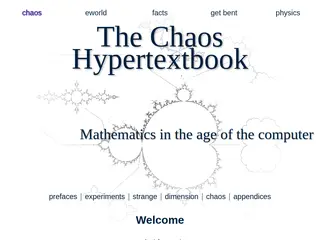
https://hypertextbook.com/chaos
The Chaos Hypertextbook is a deep educational resource covering chaos theory, fractals, strange attractors, and fractal dimension with clear explanations aimed at making complex mathematics accessible to a broad audience. Organized into chapters covering iteration, bifurcation, Julia sets, Mandelbrot sets, and nonlinear dynamics, it reads like a beautifully structured online textbook that would captivate anyone curious about the mathematics underlying unpredictable systems.
https://ptri1.tripod.com/
A detailed educational resource dedicated entirely to Pascal's Triangle, covering its construction, history, and the surprising number of patterns hidden within it. Visitors can explore topics ranging from the Fibonacci sequence and Sierpinski fractals to prime numbers and polygonal numbers, with downloadable programs to generate and visualize the triangle's patterns.
https://ncatlab.org/nlab/show/HomePage
The nLab is a collaborative wiki covering advanced mathematics, physics, and philosophy with a strong emphasis on category theory, homotopy theory, topos theory, and their connections to theoretical physics. It serves as an encyclopedic reference for researchers and students working at the intersection of higher mathematics and mathematical physics, offering thousands of deeply interlinked articles.
https://jeff560.tripod.com/mathword.html
Jeff Miller's meticulously researched reference page tracks the earliest known uses of mathematical terminology, tracing when and where specific math words first appeared in historical texts. This is a unique etymological resource for mathematicians, historians, and anyone curious about the origins of the language of mathematics.
https://planetmath.org/
PlanetMath.org is a collaboratively built mathematics encyclopedia where community members write and review entries covering a vast range of mathematical topics, all rendered in LaTeX. Hosted by the University of Waterloo and operated as a nonprofit, it offers both a subject index and alphabetical index, making it a serious reference hub for students, educators, and math enthusiasts.
https://rutar.org/
Alex Rutar is a mathematics postdoctoral researcher specializing in fractal geometry, dynamical systems, and dimension theory, with affiliations at the University of Jyväskylä and a PhD from the University of St Andrews. His site serves as an academic hub linking to his publications, expository writing, CV, and open-source developer tools built around LaTeX and terminal utilities.
https://mathcs.clarku.edu/%7Edjoyce/hilbert/toc.html
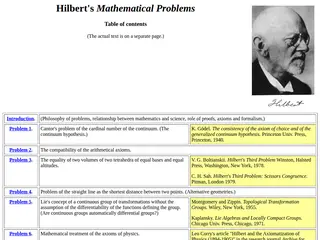
Created by David E. Joyce of Clark University, this site presents the full text of David Hilbert's famous 1900 lecture outlining 23 unsolved mathematical problems that shaped 20th-century mathematics. Each problem links to its own dedicated page with references to key solutions and related works, making it an invaluable reference for anyone studying the history and foundations of mathematics.