
Mathematics
59 sites
https://khleedril.org/blog
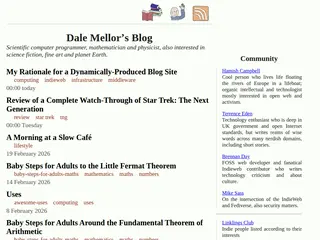
Dale Mellor is a scientific computer programmer, mathematician, and physicist who writes accessible math explainers like his 'Baby Steps for Adults' series alongside posts about science fiction, Star Trek, fine art, and daily life. The blog covers a genuinely eclectic range of intellectual interests, with mathematics and computing forming the clear backbone of the content.
https://hermetic.ch/cal_stud/jdn.htm
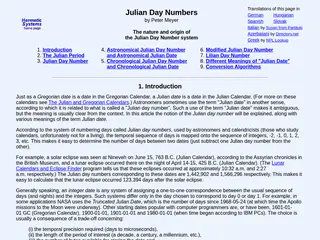
Peter Meyer's detailed reference article explains the Julian Day Number system, covering its origins, astronomical vs. chronological uses, and various related date formats like Modified Julian Day Numbers and Lilian Day Numbers. The page includes conversion algorithms and links to calendar software tools, making it a thorough technical reference for astronomers, historians, and calendricists.
http://finitegeometry.org/sc/16/quiltgeometry.html
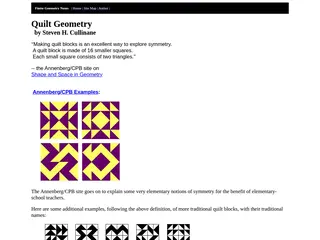
Created by Steven H. Cullinane, this page explores the mathematical geometry underlying quilt block design, connecting symmetry theory to traditional patchwork patterns. It organizes curated resources across three difficulty levels, from elementary classroom guides to advanced topics like block designs in art and mathematics.
https://mathgenealogy.org/
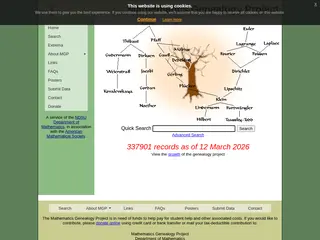
The Mathematics Genealogy Project is a massive academic database tracking the doctoral advisor lineages of mathematicians worldwide, with over 337,000 records linking students to their advisors across generations. Hosted by NDSU in association with the American Mathematical Society, it lets you trace the intellectual ancestry of virtually any mathematician back through history.
https://lostartoflogarithms.com/
Charles Petzold's web-book-in-progress explores the history, utility, and mechanics of logarithms, from their origins in 400-year-old mathematical tables to slide rules and spherical trigonometry. With over 30 chapter-length pages covering topics like the Book of Vlacq, log-log scales, and John Napier's life, this is a rich and deeply researched labor of love for math history enthusiasts.
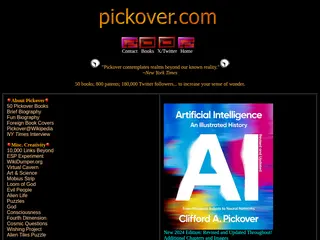
https://sprott.physics.wisc.edu/pickover/home.htm
The personal homepage of prolific author and inventor Clifford A. Pickover, featuring links to his 50+ books spanning fractals, chaos, black holes, the fourth dimension, and the mathematics of reality. With 800 patents, a sprawling collection of puzzles, art, and cosmic questions, this site is a portal into the mind of one of science's most imaginative popularizers.
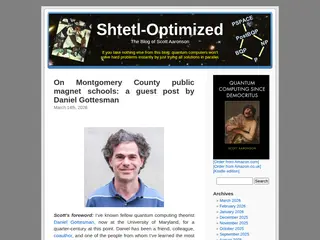
https://scottaaronson.blog/
Shtetl-Optimized is the long-running blog of Scott Aaronson, a theoretical computer scientist and quantum computing researcher, where he dives deep into complexity theory, quantum computing misconceptions, AI, and education policy. Known for its intellectual rigor and wit, it attracts readers from academia and beyond who enjoy substantive takes on math, physics, and the occasional culture-war skirmish in gifted education.
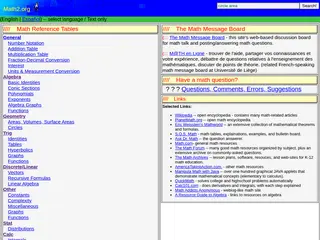
http://math2.org/
Math2.org is a comprehensive math reference site offering organized tables, formulas, and identities covering everything from basic arithmetic to calculus, linear algebra, and Fourier transforms. Available in both English and Spanish, it also features a message board for math questions and links to other top math resources on the web.
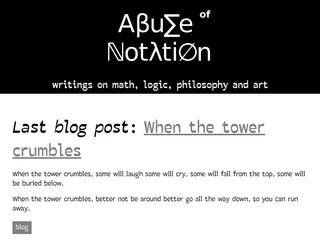
https://abuseofnotation.github.io/
Abuse of Notation is a thoughtful blog by a writer who weaves together mathematics, logic, philosophy, and programming into long-form essays and books, covering topics from category theory to Kant to functional programming. The site also features several self-authored books, including 'Category Theory Illustrated,' making it a surprisingly deep resource for readers who enjoy rigorous yet personal intellectual exploration.
http://mathpuzzle.com/loyd
Ed Pegg Jr's digitized archive of Sam Loyd's 1914 'Cyclopedia of 5000 Puzzles, Tricks, and Conundrums' presents the classic puzzle book as a complete set of scanned page images freely available for download. This rare public-domain release preserves one of the most celebrated puzzle collections in mathematical history, making it an invaluable resource for recreational mathematics enthusiasts.