
Mathematics
59 sites
https://jeff560.tripod.com/mathword.html
Jeff Miller's meticulously researched reference page tracks the earliest known uses of mathematical terminology, tracing when and where specific math words first appeared in historical texts. This is a unique etymological resource for mathematicians, historians, and anyone curious about the origins of the language of mathematics.
https://onlinestatbook.com/rvls.html
The Rice Virtual Lab in Statistics (RVLS), created by David Lane at Rice University, offers a comprehensive suite of free web-based tools for learning and teaching statistics, including an interactive online textbook, Java simulations, real-world case studies, and an analysis lab. Supported by the National Science Foundation and recognized by multiple educational organizations, it covers topics from basic descriptive statistics to ANOVA and regression.
http://nationalcurvebank.org/
The National Curve Bank is a mathematical archive dedicated to cataloging and exploring curves, offering detailed information on their properties, equations, and historical significance. A sister site to the Witch of Agnesi page, this project serves as an educational reference for students, educators, and math enthusiasts interested in the geometry of curves.

https://johnshepler.com/articles/piday.html
John Shepler's engaging article celebrates Pi Day and explores the fascinating history of the transcendental number pi, from ancient scholars to modern supercomputers crunching billions of decimal places. Packed with fun facts, literary references, and links to birthday calculators and playlists, it makes mathematics genuinely entertaining for casual readers and math enthusiasts alike.
https://www.andrews.edu/~burton/mathlinks/coolmathlinks.htm
A curated collection of mathematics education links compiled at Andrews University, organized into sections for teachers, parents, and students across K-12 grade levels. The directory covers lesson plans, interactive activities, problem-solving resources, and NCTM-aligned curriculum materials from across the early web.
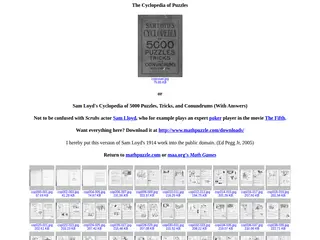
http://mathpuzzle.com/loyd
Ed Pegg Jr's digitized archive of Sam Loyd's 1914 'Cyclopedia of 5000 Puzzles, Tricks, and Conundrums' presents the classic puzzle book as a complete set of scanned page images freely available for download. This rare public-domain release preserves one of the most celebrated puzzle collections in mathematical history, making it an invaluable resource for recreational mathematics enthusiasts.
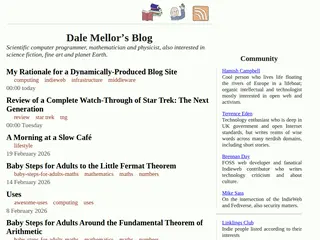
https://khleedril.org/blog
Dale Mellor is a scientific computer programmer, mathematician, and physicist who writes accessible math explainers like his 'Baby Steps for Adults' series alongside posts about science fiction, Star Trek, fine art, and daily life. The blog covers a genuinely eclectic range of intellectual interests, with mathematics and computing forming the clear backbone of the content.
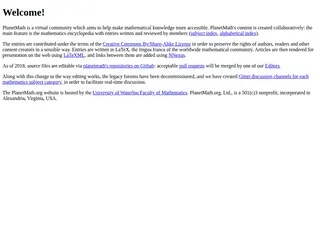
https://planetmath.org/
PlanetMath.org is a collaboratively built mathematics encyclopedia where community members write and review entries covering a vast range of mathematical topics, all rendered in LaTeX. Hosted by the University of Waterloo and operated as a nonprofit, it offers both a subject index and alphabetical index, making it a serious reference hub for students, educators, and math enthusiasts.
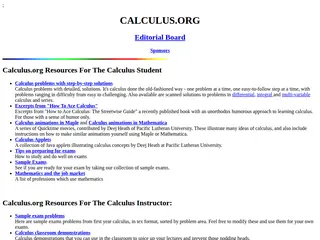
http://math.ucdavis.edu/~calculus
Calculus.org is a comprehensive educational hub hosted by UC Davis, offering step-by-step calculus problems, Java applets, Maple and Mathematica animations, and sample exams for both students and instructors. The site covers differential, integral, and multivariable calculus with resources ranging from humorous beginner guides to actuarial review problems, making it a well-rounded reference for anyone tackling the subject.
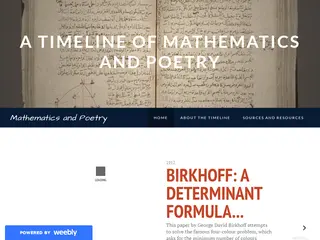
http://mathematicalpoets.weebly.com/
A research project exploring the intersection of mathematics and poetry through a historical timeline tracing connections between mathematicians and poets across the centuries. The site offers a curated timeline, sources, and resources for anyone curious about how these two disciplines have influenced each other.