
Mathematics
59 sites
http://nationalcurvebank.org/
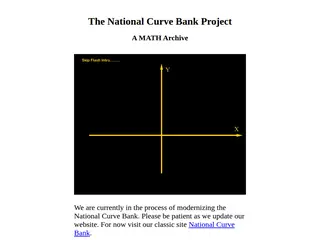
The National Curve Bank is a mathematical archive dedicated to cataloging and exploring curves, offering detailed information on their properties, equations, and historical significance. A sister site to the Witch of Agnesi page, this project serves as an educational reference for students, educators, and math enthusiasts interested in the geometry of curves.
https://math.ucr.edu/home/baez
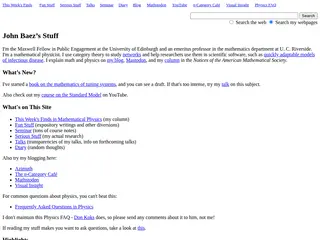
John Baez is a mathematical physicist and emeritus professor at UC Riverside whose sprawling personal site features decades of expository writing on math and physics, including his long-running column 'This Week's Finds in Mathematical Physics.' Visitors can explore course notes, research papers, talks on topics from category theory to the Standard Model, and accessible blog posts bridging cutting-edge science with public engagement.
https://mathgenealogy.org/
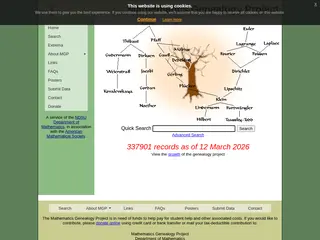
The Mathematics Genealogy Project is a massive academic database tracking the doctoral advisor lineages of mathematicians worldwide, with over 337,000 records linking students to their advisors across generations. Hosted by NDSU in association with the American Mathematical Society, it lets you trace the intellectual ancestry of virtually any mathematician back through history.
https://sprott.physics.wisc.edu/pickover/home.htm
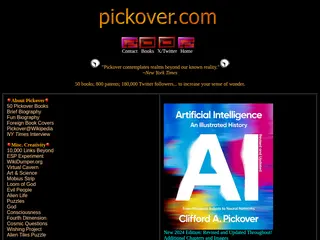
The personal homepage of prolific author and inventor Clifford A. Pickover, featuring links to his 50+ books spanning fractals, chaos, black holes, the fourth dimension, and the mathematics of reality. With 800 patents, a sprawling collection of puzzles, art, and cosmic questions, this site is a portal into the mind of one of science's most imaginative popularizers.
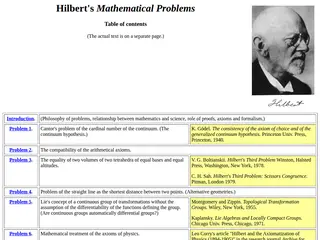
https://mathcs.clarku.edu/%7Edjoyce/hilbert/toc.html
Created by David E. Joyce of Clark University, this site presents the full text of David Hilbert's famous 1900 lecture outlining 23 unsolved mathematical problems that shaped 20th-century mathematics. Each problem links to its own dedicated page with references to key solutions and related works, making it an invaluable reference for anyone studying the history and foundations of mathematics.
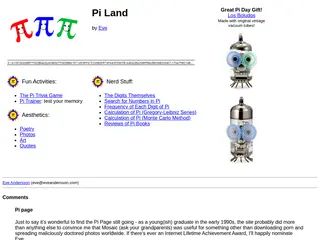
http://eveandersson.com/pi
Pi Land is Eve Andersson's comprehensive tribute to the mathematical constant pi, featuring trivia games, a memory trainer, digit search tools, frequency analysis, and multiple calculation methods including Gregory-Leibniz and Monte Carlo. The site blends nerdy exploration with aesthetic touches like poetry, photos, and art, making it a delightful destination for math enthusiasts of all levels.
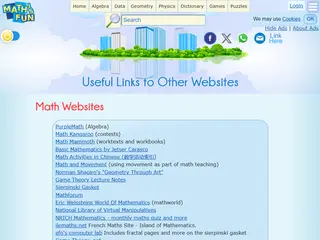
https://www.mathsisfun.com/links/external.html
A curated collection of external math links from MathIsFun, organized into math websites, fun puzzle sites, and schools, covering everything from algebra and geometry to game theory and Pi. Created by Rod Pierce, this page serves as a springboard to some of the web's best math resources for students, teachers, and curious minds alike.
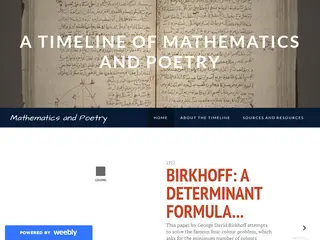
http://mathematicalpoets.weebly.com/
A research project exploring the intersection of mathematics and poetry through a historical timeline tracing connections between mathematicians and poets across the centuries. The site offers a curated timeline, sources, and resources for anyone curious about how these two disciplines have influenced each other.
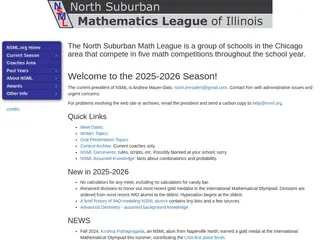
https://nsml.org/
The North Suburban Math League (NSML) organizes competitive math meets for Chicago-area high schools, with five competitions held throughout the school year. The site provides contest archives, meet schedules, written and oral topic lists, coach resources, and a history of NSML alumni who have earned medals at the International Mathematical Olympiad.
http://geom.uiuc.edu/
The Geometry Center was a University of Minnesota research and education hub dedicated to mathematics, geometry, and visualization tools, now archived after its closure. Visitors can explore interactive Java applications, 3D geometry software like Geomview and JGV, multimedia math documents, downloadable software, and video productions covering topics from solar system models to symmetry exploration.