
Mathematics
59 sites
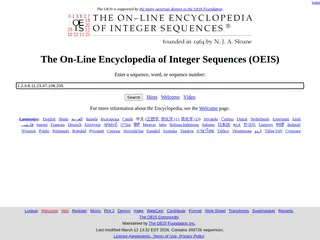
https://oeis.org/
The OEIS is a massive searchable database of over 393,000 integer sequences, maintained by the OEIS Foundation and originally created by mathematician Neil Sloane. Researchers, students, and math enthusiasts can look up sequences by entering numbers to identify patterns, explore combinatorics, and discover connections across mathematical disciplines.
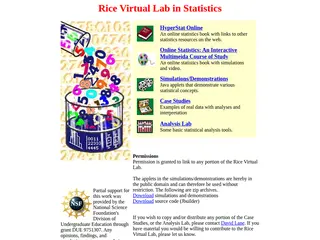
https://onlinestatbook.com/rvls.html
The Rice Virtual Lab in Statistics (RVLS), created by David Lane at Rice University, offers a comprehensive suite of free web-based tools for learning and teaching statistics, including an interactive online textbook, Java simulations, real-world case studies, and an analysis lab. Supported by the National Science Foundation and recognized by multiple educational organizations, it covers topics from basic descriptive statistics to ANOVA and regression.

https://pglpm.github.io/Pinference
Pinference is an R package by PierGianLuca Porta Mana that implements probability inference for propositional logic, calculating lower and upper probability bounds for logical expressions using Hailperin's procedure. The documentation site covers the theoretical foundations connecting probability calculus to sequent calculus, with worked examples and an API reference for the inferP() function.
http://nationalcurvebank.org/
The National Curve Bank is a mathematical archive dedicated to cataloging and exploring curves, offering detailed information on their properties, equations, and historical significance. A sister site to the Witch of Agnesi page, this project serves as an educational reference for students, educators, and math enthusiasts interested in the geometry of curves.
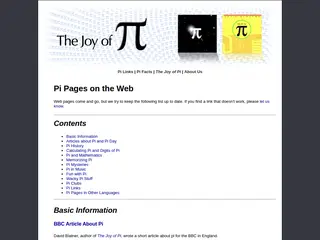
http://joyofpi.com/pilinks.html
A comprehensive link directory dedicated entirely to pi, curated by David Blatner, author of 'The Joy of Pi,' covering everything from basic pi facts and digit downloads to pi music, pi history, and Pi Day celebrations. Visitors will find hundreds of categorized links spanning memorizing pi, calculating digits, pi mysteries, and even wacky pi fun, making it a go-to hub for pi enthusiasts of all levels.

https://complex-analysis.com/
Created by Juan Carlos Ponce Campuzano, this interactive online textbook introduces complex analysis through visual applets built with GeoGebra, p5.js, and other JavaScript tools, making abstract mathematical concepts tangible and explorable. Covering topics from the Cauchy-Goursat Theorem to conformal mappings, it serves engineering and mathematics students with a beautifully designed, continually updated resource that includes Spanish and Italian translations.
https://www.mathsisfun.com/links/external.html
A curated collection of external math links from MathIsFun, organized into math websites, fun puzzle sites, and schools, covering everything from algebra and geometry to game theory and Pi. Created by Rod Pierce, this page serves as a springboard to some of the web's best math resources for students, teachers, and curious minds alike.
https://hermetic.ch/cal_stud/jdn.htm
Peter Meyer's detailed reference article explains the Julian Day Number system, covering its origins, astronomical vs. chronological uses, and various related date formats like Modified Julian Day Numbers and Lilian Day Numbers. The page includes conversion algorithms and links to calendar software tools, making it a thorough technical reference for astronomers, historians, and calendricists.
http://mathematicalpoets.weebly.com/
A research project exploring the intersection of mathematics and poetry through a historical timeline tracing connections between mathematicians and poets across the centuries. The site offers a curated timeline, sources, and resources for anyone curious about how these two disciplines have influenced each other.