
Philosophy
121 sites
http://pragmatism.org/
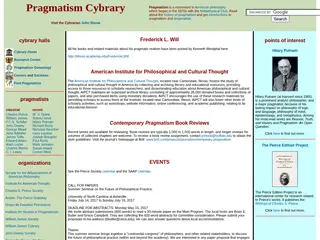
The Pragmatism Cybrary, curated by John Shook, is a comprehensive reference hub dedicated to the American philosophical movement of pragmatism, covering its history from the 1870s Metaphysical Club through contemporary thinkers. Visitors can explore detailed profiles of classical and recent pragmatists from Charles Peirce and William James to Cornel West and Susan Haack, alongside links to research centers, scholarly societies, and related archives.
http://newbanner.com/
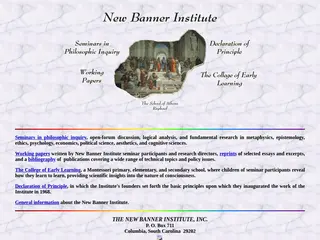
The New Banner Institute is a Columbia, South Carolina organization founded in 1968 dedicated to philosophic inquiry spanning metaphysics, epistemology, ethics, economics, and cognitive science, drawing on Objectivist and Aristotelian traditions. Visitors can explore working papers, seminar materials, a bibliography of publications, and information about the affiliated College of Early Learning, a Montessori school studying how children develop consciousness.
https://e-anglais.com/thesis.html
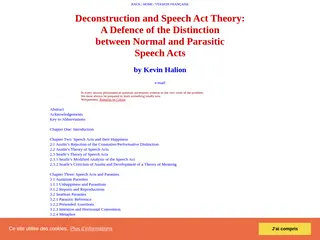
Kevin Halion's full academic thesis presents a rigorous defense of the distinction between normal and parasitic speech acts, engaging the famous philosophical debate between Jacques Derrida and John Searle over Austin's speech act theory. The work is organized into detailed chapters covering iterability, deconstruction, performatives, and the graphematic nature of language, making it a substantial scholarly resource for anyone studying philosophy of language.

https://josh.works/
Josh Thompson's personal scratch pad digs into urban economics, zoning laws, land use policy, and walkable city design, drawing on works like Marie-Agnes and Alain Bertaud's 'Order Without Design' and Christopher Alexander's 'A Pattern Language'. The site blends thoughtful analysis of city planning failures with street-level illustrations of pedestrian path patterns, making dense policy topics surprisingly approachable.
https://victoria.neocities.org/
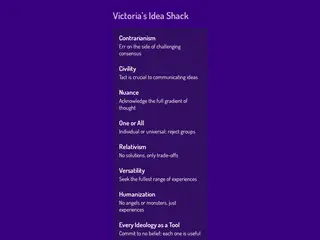
Victoria's Idea Shack is a minimalist personal site built around a set of intellectual principles including contrarianism, nuance, relativism, and humanization. The site presents a philosophical framework for engaging with ideas, rejecting ideological commitment in favor of treating every belief as a useful tool, with an essays section promising deeper exploration.
https://capone.mtsu.edu/rbombard/RB/spinoza.new.html
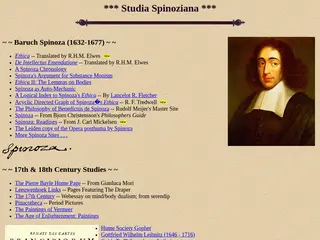
Studia Spinoziana is a scholarly resource hub dedicated to the 17th-century philosopher Baruch Spinoza, offering translated texts of the Ethica and De Intellectus Emendatione, chronologies, logical indexes, and directed graphs of his arguments. Beyond Spinoza, it extends into broader early modern philosophy with curated links to Descartes, Leibniz, Rousseau, Hume, and Enlightenment-era primary sources.

https://geartoward.jp.net/
A personal site where the creator shares opinions and perspectives on subjects that may be controversial or unconventional, inviting visitors to approach with an open mind. The programming-style intro ('int Main (void) {}') gives it a distinctive nerdy flair, hinting at a tech-savvy author with something to say.
http://particularvirtue.blogspot.com/
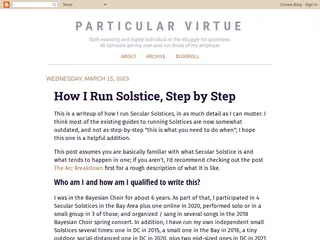
Particular Virtue is a thoughtful blog by 'evictorial' exploring rationalist community life, secular rituals, and personal ethics, with detailed guides like how to organize a Secular Solstice event. Posts range from practical community-organizing advice to reflections on work, meaning, and the rationalist subculture centered around the Bay Area and DC.
http://friedrichnietzsche.de/
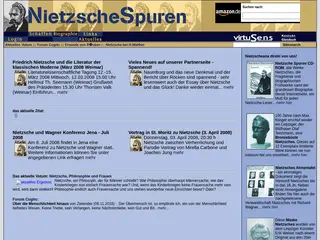
A comprehensive German-language resource dedicated to Friedrich Nietzsche, covering his life, works, and the people around him, including full-text search of his writings and biographical materials. The site features conference announcements, forum discussions, quotes, a CD-ROM product, and essays exploring Nietzsche's philosophy, his relationship with Wagner, and topics like the Übermensch.
http://soli.com/philo.htm
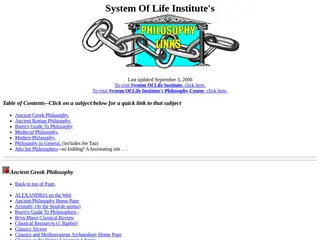
The System Of Life Institute's Philosophy Links page offers an extensive curated directory of philosophical resources organized by era, covering Ancient Greek, Roman, Medieval, and Modern philosophy alongside the Tao. With over 140 links spanning Perseus Project, Epicurean philosophy, Bjorn's Guide to Philosophers, and even job listings for philosophers, it serves as a broad gateway into academic and classical philosophical study.