
Physics
30 sites
https://golem.ph.utexas.edu/string/index.shtml
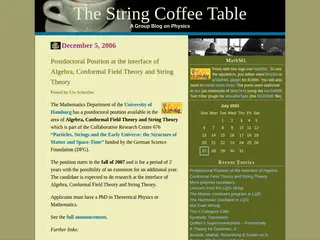
The String Coffee Table is a collaborative group blog hosted at the University of Texas at Austin, bringing together physicists to discuss string theory, loop quantum gravity, conformal field theory, and related advanced topics. Posts make heavy use of MathML for rendering equations, and contributors include researchers like Urs Schreiber and Lubos Motl, making it a rich academic resource for cutting-edge theoretical physics.
https://julianbunn.org/
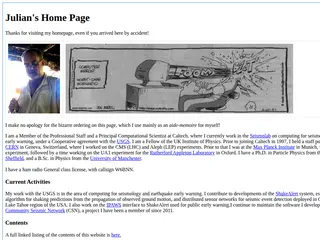
Julian Bunn is a computational scientist at Caltech with a background in particle physics at CERN, DESY, and the Rutherford Appleton Laboratory, now working on seismology and earthquake early warning systems like ShakeAlert. His sprawling homepage serves as a personal aide-memoire covering decades of scientific work, publications, ham radio, genetic algorithms, and even obscure retro computing projects from the DECUS era.
https://physicspages.com/
PhysicsPages is a detailed self-study companion covering classical mechanics, quantum mechanics, electrodynamics, relativity, string theory, and more, written with honest, jargon-free explanations that avoid the dreaded 'obviously' of typical textbooks. The creator presents rigorous, math-heavy notes designed for university students or independent learners working through structured physics topics.
http://insti.physics.sunysb.edu/physics/physics_links.htm
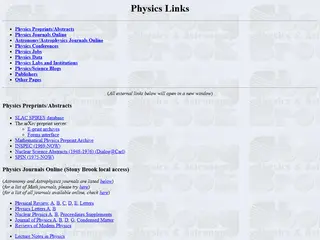
Maintained by Stony Brook University's physics department, this extensive link directory covers physics preprints, online journals, conferences, jobs, data sources, and institutions. Researchers and students will find hundreds of curated links spanning Physical Review, arXiv, SLAC SPIRES, astrophysics journals, and community resources like Fermilab and the Nobel Foundation.
http://damtp.cam.ac.uk/user/tong/teaching.html
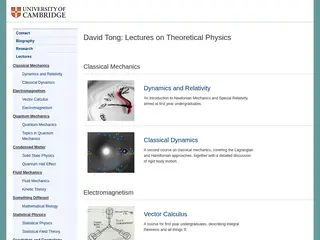
David Tong, a professor at Cambridge University, offers a comprehensive collection of free lecture notes covering nearly every area of theoretical physics, from classical mechanics and electromagnetism to quantum field theory and string theory. The notes are aimed at undergraduates and graduate students and represent a genuinely deep academic resource, with dozens of individual courses each spanning multiple topics.
http://cwp.library.ucla.edu/
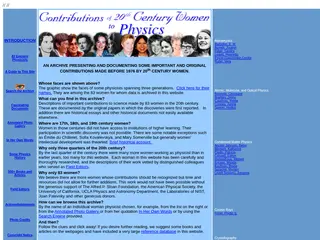
Hosted by UCLA, this scholarly archive documents the original scientific contributions of 83 eminent women physicists who worked before 1976, drawing on primary sources including the papers in which their discoveries were first reported. Visitors can explore an annotated photo gallery, historical essays, a searchable database, and firsthand accounts spanning fields from nuclear physics to space physics.
https://farside.ph.utexas.edu/
Richard Fitzpatrick is a Professor of Physics at the University of Texas at Austin, specializing in fusion studies, with this page serving as a hub for his research, teaching materials, academic papers, talks, and books. Visitors interested in plasma physics or fusion energy will find a gateway to substantial scholarly resources from an active academic researcher.
https://faraday.physics.utoronto.ca/GeneralInterest/Harrison/Flash
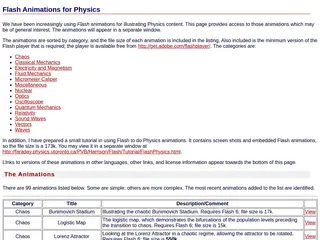
Created by a University of Toronto physicist, this collection features 99 Flash animations covering topics from Quantum Mechanics and Relativity to Chaos and Fluid Mechanics, making abstract physics concepts visually intuitive. A bonus tutorial teaches how to build your own physics animations in Flash, and the animations are available in multiple languages under a Creative Commons license.
http://insti.physics.sunysb.edu/~siegel/quack.html
A physics professor at SUNY Stony Brook takes aim at pseudoscience and scientific quackery, exploring the psychological and personality traits that lead people to reject well-established science like evolution, vaccination, and modern physics. The page is a sharp, witty critique of fringe theorists who show up insisting their ideas will overturn all known physics, drawing a careful distinction between bold legitimate scientists and true cranks.
https://math.columbia.edu/~woit/wordpress?p=15620
Peter Woit's 'Not Even Wrong' is a long-running physics blog hosted at Columbia University, covering cutting-edge topics in theoretical physics including twistor theory, quantum field theory, and the mathematics of unification. Woit writes with deep technical expertise and a critical perspective, making this a destination for mathematically sophisticated readers interested in the foundations of modern physics.