
Physics
30 sites
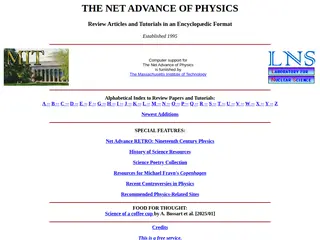
http://web.mit.edu/redingtn/www/netadv/welcome.html
Created by Norman Hugh Redington at MIT, The Net Advance of Physics is an encyclopedic collection of review articles and tutorials covering the full breadth of physics, organized alphabetically and continuously updated since 1995. Special features include a 19th century physics retro archive, history of science resources, a science poetry collection, and curated links to recent controversies in the field.
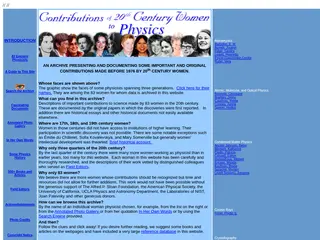
http://cwp.library.ucla.edu/
Hosted by UCLA, this scholarly archive documents the original scientific contributions of 83 eminent women physicists who worked before 1976, drawing on primary sources including the papers in which their discoveries were first reported. Visitors can explore an annotated photo gallery, historical essays, a searchable database, and firsthand accounts spanning fields from nuclear physics to space physics.
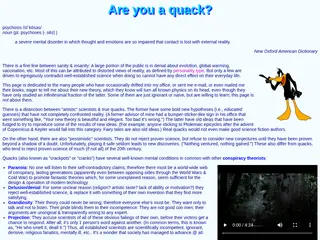
http://insti.physics.sunysb.edu/~siegel/quack.html
A physics professor at SUNY Stony Brook takes aim at pseudoscience and scientific quackery, exploring the psychological and personality traits that lead people to reject well-established science like evolution, vaccination, and modern physics. The page is a sharp, witty critique of fringe theorists who show up insisting their ideas will overturn all known physics, drawing a careful distinction between bold legitimate scientists and true cranks.
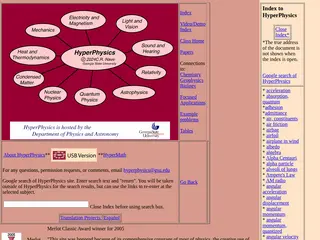
http://hyperphysics.phy-astr.gsu.edu/hbase/hframe.html
HyperPhysics is a sprawling educational reference site from Georgia State University covering virtually every topic in physics through an interconnected web of concept maps and concise explanations. Visitors can explore everything from classical mechanics and thermodynamics to quantum physics and relativity, with formulas, diagrams, and worked examples throughout.
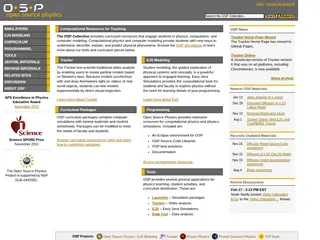
https://compadre.org/osp
The Open Source Physics project, supported by NSF and the AAPT, provides free computational curriculum resources including simulations, modeling tools, and student worksheets designed to help learners explore physical phenomena through computer modeling. Highlights include the Tracker video analysis tool and Easy Java Simulations (EJS) framework, making it a comprehensive hub for physics educators and students at all levels.
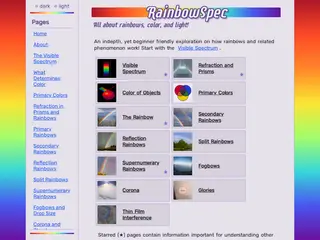
https://rainbowspec.observer/
RainbowSpec is an in-depth yet beginner-friendly educational site exploring how rainbows and color work, covering everything from the visible spectrum and refraction to supernumerary rainbows, fogbows, glories, and thin film interference. The site is thoughtfully organized with starred pages marking foundational concepts, and it links to classic atmospheric optics references that inspired its creation.
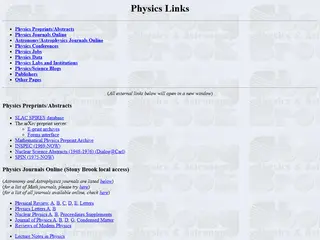
http://insti.physics.sunysb.edu/physics/physics_links.htm
Maintained by Stony Brook University's physics department, this extensive link directory covers physics preprints, online journals, conferences, jobs, data sources, and institutions. Researchers and students will find hundreds of curated links spanning Physical Review, arXiv, SLAC SPIRES, astrophysics journals, and community resources like Fermilab and the Nobel Foundation.
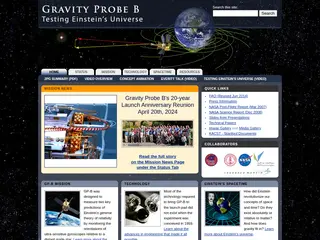
http://einstein.stanford.edu/
The official site for NASA's Gravity Probe B mission, a Stanford University experiment designed to test two key predictions of Einstein's general theory of relativity using ultra-precise gyroscopes orbiting Earth. Visitors can explore the mission's history dating back to 1959, the groundbreaking engineering advances required to make it possible, technical papers, image galleries, and video overviews of spacetime concepts.
https://physicspages.com/
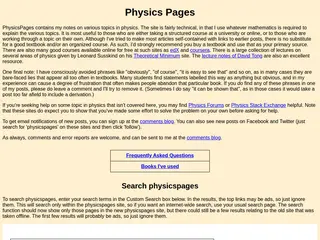
PhysicsPages is a detailed self-study companion covering classical mechanics, quantum mechanics, electrodynamics, relativity, string theory, and more, written with honest, jargon-free explanations that avoid the dreaded 'obviously' of typical textbooks. The creator presents rigorous, math-heavy notes designed for university students or independent learners working through structured physics topics.
http://rgbrown.org/
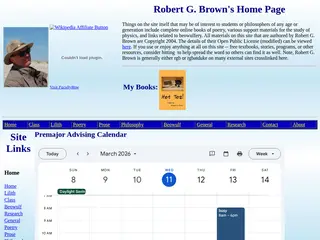
Robert G. Brown, a physicist at Duke University, shares an extensive collection of free online textbooks, physics study materials, poetry collections, philosophy essays, and beowulf cluster computing resources. The site is a sprawling intellectual hub covering everything from GPL software tools to metaphysics, all freely licensed under an open public license.