
Physics
30 sites
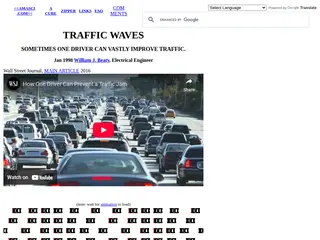
http://trafficwaves.org/
William J. Beaty, an electrical engineer from Seattle, explores the fascinating physics of traffic jams, treating highway congestion as fluid dynamics and demonstrating how a single driver can dissolve traffic waves. The site features animations, videos, experiments, and links to academic research on 'jam-absorption driving,' making it a surprisingly deep dive into an everyday phenomenon.
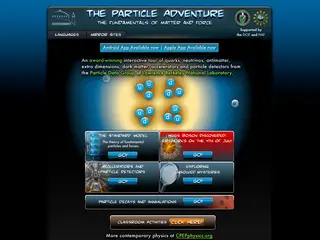
https://particleadventure.org/
The Particle Adventure is an award-winning interactive guide to particle physics from the Particle Data Group at Lawrence Berkeley National Laboratory, covering quarks, neutrinos, the Higgs boson, dark matter, antimatter, and particle accelerators. Available in over a dozen languages and designed for students and curious minds alike, it offers classroom activities, particle history charts, and deep dives into the fundamental building blocks of the universe.
https://physicspages.com/
PhysicsPages is a detailed self-study companion covering classical mechanics, quantum mechanics, electrodynamics, relativity, string theory, and more, written with honest, jargon-free explanations that avoid the dreaded 'obviously' of typical textbooks. The creator presents rigorous, math-heavy notes designed for university students or independent learners working through structured physics topics.

http://chaos.umd.edu/
The Chaos Group at the University of Maryland presents their research into chaotic dynamics, covering topics like fractal basin boundaries, chaotic scattering, strange attractors, and controlling chaos. Affiliated with multiple departments including Physics, Mathematics, and Electrical Engineering, this site offers a window into decades of groundbreaking nonlinear dynamics research dating back to the mid-1970s.
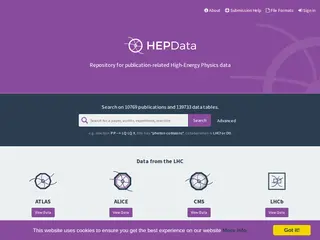
https://hepdata.net/
HEPData is an open repository for publication-related High-Energy Physics data, hosting experimental datasets from major LHC collaborations including ATLAS, ALICE, CMS, and LHCb. Researchers can search and submit data using advanced query syntax, making it an essential reference tool for particle physics scientists worldwide.
http://cwp.library.ucla.edu/
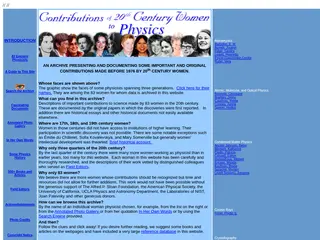
Hosted by UCLA, this scholarly archive documents the original scientific contributions of 83 eminent women physicists who worked before 1976, drawing on primary sources including the papers in which their discoveries were first reported. Visitors can explore an annotated photo gallery, historical essays, a searchable database, and firsthand accounts spanning fields from nuclear physics to space physics.
https://compadre.org/osp
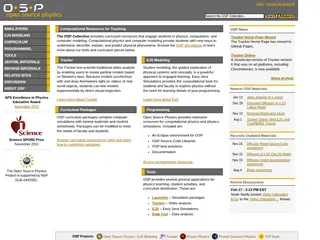
The Open Source Physics project, supported by NSF and the AAPT, provides free computational curriculum resources including simulations, modeling tools, and student worksheets designed to help learners explore physical phenomena through computer modeling. Highlights include the Tracker video analysis tool and Easy Java Simulations (EJS) framework, making it a comprehensive hub for physics educators and students at all levels.
http://einstein.stanford.edu/
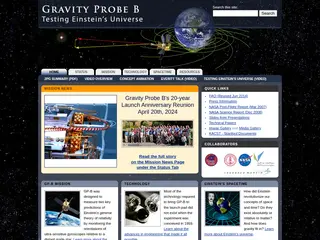
The official site for NASA's Gravity Probe B mission, a Stanford University experiment designed to test two key predictions of Einstein's general theory of relativity using ultra-precise gyroscopes orbiting Earth. Visitors can explore the mission's history dating back to 1959, the groundbreaking engineering advances required to make it possible, technical papers, image galleries, and video overviews of spacetime concepts.
https://mikedaub.com/
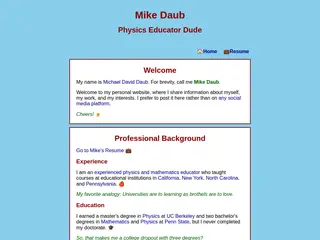
Mike Daub is a physics and mathematics educator with a master's from UC Berkeley who spent five seasons at the South Pole researching experimental cosmology on the ACBAR project. His personal site covers his academic background, libertarian politics, photography, and a no-nonsense hand-coded HTML philosophy with no frameworks or tracking.
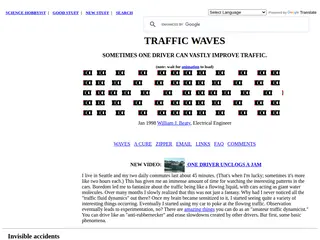
http://amasci.com/amateur/traffic/traffic1.html
William J. Beaty, a Seattle electrical engineer, explores the fascinating physics of traffic jams, showing how waves propagate through congested highways much like fluid dynamics. The site features animations, experiments, and practical techniques for how a single driver can actually dissolve traffic slowdowns, making it a genuinely mind-expanding read for any commuter.