
Physics
30 sites
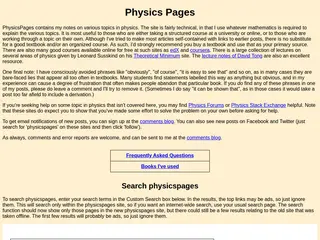
https://physicspages.com/
PhysicsPages is a detailed self-study companion covering classical mechanics, quantum mechanics, electrodynamics, relativity, string theory, and more, written with honest, jargon-free explanations that avoid the dreaded 'obviously' of typical textbooks. The creator presents rigorous, math-heavy notes designed for university students or independent learners working through structured physics topics.
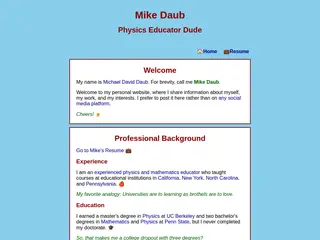
https://mikedaub.com/
Mike Daub is a physics and mathematics educator with a master's from UC Berkeley who spent five seasons at the South Pole researching experimental cosmology on the ACBAR project. His personal site covers his academic background, libertarian politics, photography, and a no-nonsense hand-coded HTML philosophy with no frameworks or tracking.
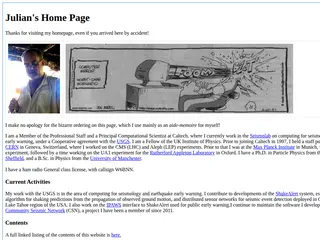
https://julianbunn.org/
Julian Bunn is a computational scientist at Caltech with a background in particle physics at CERN, DESY, and the Rutherford Appleton Laboratory, now working on seismology and earthquake early warning systems like ShakeAlert. His sprawling homepage serves as a personal aide-memoire covering decades of scientific work, publications, ham radio, genetic algorithms, and even obscure retro computing projects from the DECUS era.
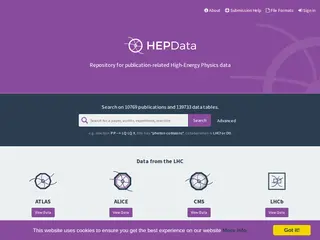
https://hepdata.net/
HEPData is an open repository for publication-related High-Energy Physics data, hosting experimental datasets from major LHC collaborations including ATLAS, ALICE, CMS, and LHCb. Researchers can search and submit data using advanced query syntax, making it an essential reference tool for particle physics scientists worldwide.
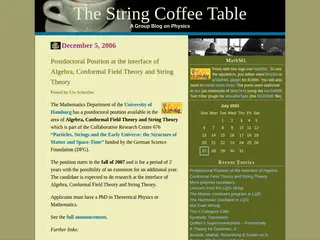
https://golem.ph.utexas.edu/string/index.shtml
The String Coffee Table is a collaborative group blog hosted at the University of Texas at Austin, bringing together physicists to discuss string theory, loop quantum gravity, conformal field theory, and related advanced topics. Posts make heavy use of MathML for rendering equations, and contributors include researchers like Urs Schreiber and Lubos Motl, making it a rich academic resource for cutting-edge theoretical physics.
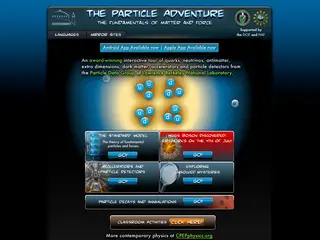
https://particleadventure.org/
The Particle Adventure is an award-winning interactive guide to particle physics from the Particle Data Group at Lawrence Berkeley National Laboratory, covering quarks, neutrinos, the Higgs boson, dark matter, antimatter, and particle accelerators. Available in over a dozen languages and designed for students and curious minds alike, it offers classroom activities, particle history charts, and deep dives into the fundamental building blocks of the universe.
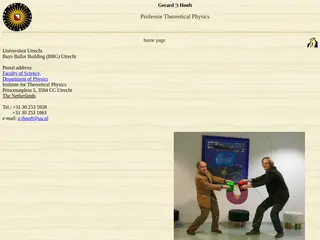
https://webspace.science.uu.nl/~hooft101
The official homepage of Gerard 't Hooft, Nobel Prize-winning theoretical physicist at Utrecht University, covering his research into quantum mechanics, quantum field theory, and black hole physics. Visitors can access his lecture notes, publication list, curriculum vitae, and his ongoing work on deterministic quantum mechanics and the origins of quantum behavior.
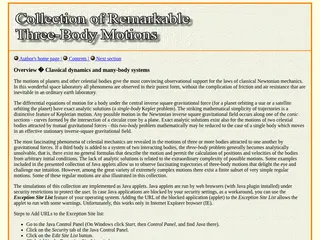
http://butikov.faculty.ifmo.ru/Projects/Collection.html
Created by physicist E. Butikov of IFMO, this collection presents interactive Java applets simulating remarkable three-body gravitational motion problems, including the famous figure-eight periodic orbit and restricted three-body scenarios. It bridges classical Newtonian mechanics and celestial mechanics with hands-on simulations suitable for students and advanced researchers exploring planetary system dynamics.
https://physlink.com/
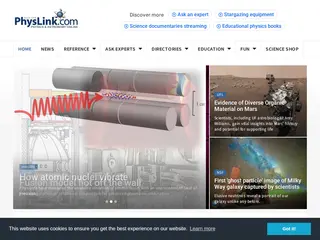
Founded in 1995 by physicist Anton Skorucak, PhysLink.com is a comprehensive online portal covering physics and astronomy through reference materials, expert Q&A, physical constants, calculators, and educational articles. Visitors can explore everything from quantum mechanics and general relativity to astronomy news, Nobel Prize info, and even physics humor and cartoons.
https://faraday.physics.utoronto.ca/GeneralInterest/Harrison/Flash
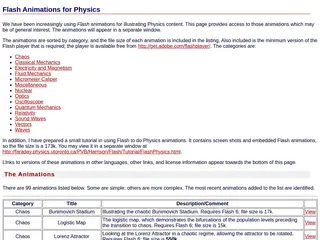
Created by a University of Toronto physicist, this collection features 99 Flash animations covering topics from Quantum Mechanics and Relativity to Chaos and Fluid Mechanics, making abstract physics concepts visually intuitive. A bonus tutorial teaches how to build your own physics animations in Flash, and the animations are available in multiple languages under a Creative Commons license.