
Programming
535 sites
https://essem.space/
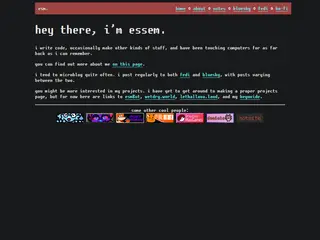
Essem's personal homepage showcases a developer who builds open-source projects including esmBot and runs Fediverse instances like wetdry.world and lethallava.land. The site serves as a hub linking to their code projects, microblogging presence on both Fediverse and Bluesky, and a Ko-fi support page.
https://akbatten.com/
AKBatten is a personal project write-up site covering a wide range of technical topics including self-hosted web services, embedded systems, Linux configuration, and ham radio builds. The creator documents hands-on projects like designing a CPU architecture, deploying Nextcloud, building DIY antennas, and programming a Nintendo DS, making it a rewarding browse for hardware and software hobbyists alike.
https://fordhurley.com/
Ford Hurley's personal site showcases an impressive portfolio of software projects, including GLSL shader tools, WebGL utilities, open source contributions, and even an online multiplayer board game. With a mix of creative coding experiments, professional work history, and academic publications in proton CT scanning, it offers a fascinating window into the mind of a developer who ranges from GPU programming to Bitcoin mining hardware.
https://klimson.dev/
Klimson's personal developer site serves as a hub for a Polish programmer, featuring links to projects, a blog about things they find interesting, and a contact page. The site showcases GitHub projects and participates in the Hotline Webring, reflecting its roots in the indie web community.

https://mabbs.github.io/
Mayx's technical blog covers hands-on explorations of LLM deployment, XML/XSLT transformations, running Linux in the browser via WASM, Git repository recovery, and other programming curiosities. With 180 articles and over 620,000 characters of content, this Chinese-language developer blog is a rich archive of practical computing experiments and software engineering discoveries.
https://backdrifting.net/post/080_machine_learning_crash_course
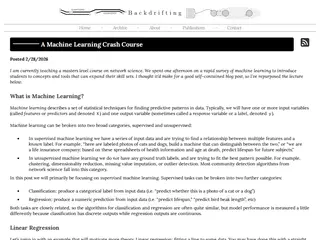
Milo Trujillo's technical blog features a detailed machine learning crash course repurposed from a real masters-level network science lecture, covering supervised and unsupervised learning with code examples. The post walks through foundational ML concepts, feature preparation, and hands-on techniques using datasets like California Housing, making it a genuinely useful self-contained reference for students and developers.
http://wiki.c2.com/?CamelCase=
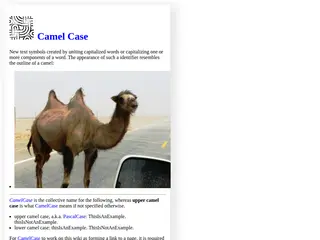
This is the legendary Ward Cunningham wiki (c2.com), the original wiki ever created, focused on software development, programming patterns, and computer science concepts. The CamelCase page specifically documents the WikiWord naming convention that became foundational to wiki culture and collaborative web-based knowledge systems.
http://curt.com/
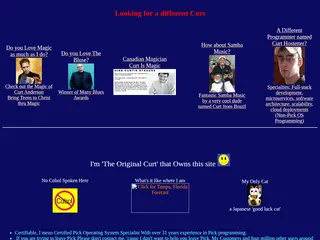
Curt's personal homepage doubles as a professional showcase for his 31-plus years of experience as a Pick Operating System specialist and consultant, listing real-world clients across industries from HVAC to contact lens manufacturing. Visitors also find links to his photographs, philosophy of life, and a quirky disambiguation section connecting to other people named Curt around the web.
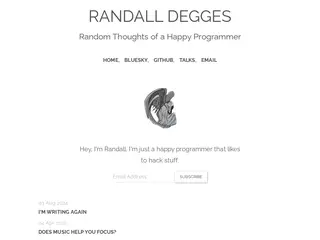
https://www.rdegges.com/
Randall Degges, a self-described 'happy programmer,' shares his thoughts on software development, web security, APIs, authentication, and the occasional personal finance or lifestyle post. The archive spans over a decade of technical writing, covering topics from GraphQL and Django to local storage pitfalls and cryptocurrency mining.

https://nilfm.cc/
The personal digital garden of Iris (nilix), a self-described software artisan and cybernetic witch, covering an eclectic mix of software projects, rollerblading, occult interests, permacomputing, degrowth, and Buddhist philosophy. The site is a richly interconnected 'memex'-style space with a blog, photojournal, shrines, and handwritten notes spanning topics from gamedev to ecology.