
Programming
535 sites

https://rodneybrooks.com/
Rodney Brooks, the renowned roboticist and AI researcher behind iRobot and Rethinking Robotics, maintains this personal blog covering robots, artificial intelligence, and related topics. The site serves as a hub linking to his blog, his MIT work, and his company Robust.AI, making it a destination for anyone following cutting-edge robotics and AI thinking.
https://mackido.com/Software/SoYouWantToProgram.html
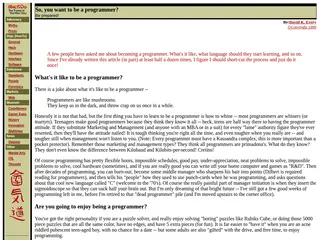
David K. Every's humorous and candid guide walks aspiring programmers through what the profession is really like, covering programmer culture, attitudes, and what to expect when starting out. Part of the larger MacKiDo reference site, this article blends sharp wit with practical insight to give beginners an honest (and entertaining) introduction to the programming world.
http://ctyme.com/rbrown.htm
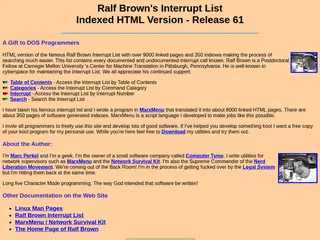
An HTML conversion of Ralf Brown's legendary Interrupt List, one of the most comprehensive references for DOS interrupt calls ever assembled, featuring over 9000 linked pages and 350 searchable indexes. Created by Marc Perkel of Computer Tyme, this invaluable resource documents every known documented and undocumented DOS interrupt call, making it an essential bookmark for low-level and assembly language programmers.
https://vyaskn.tripod.com/handling_email_addresses_in_sql_server.htm
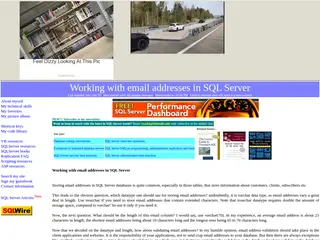
Narayana Vyas Kondreddi's technical page dives deep into SQL Server topics, with this article covering how to properly store, validate, and restrict access to email addresses in SQL Server databases using T-SQL. The site also hosts a broader library of SQL Server resources, FAQs on replication, Visual Basic code samples, and ASP references.
https://pleac.sourceforge.net/
PLEAC (Programming Language Examples Alike Cookbook) is a collaborative reference project that reimplements the classic Perl Cookbook's solutions across multiple programming languages including Python, Ruby, OCaml, Groovy, and Guile. It serves as a side-by-side comparison tool for developers wanting to see how common programming problems are solved in different languages, making it invaluable for polyglot programmers and language learners.
https://matija.suklje.name/
Matija Šuklje, known online as Hook, writes at the intersection of free and open source software law, licensing, and hacker culture, bringing a lawyer's precision to the FOSS world. Posts range from copyright and licensing proposals like REUSE.software and the Fiduciary License Agreement to KDE integration projects and the occasional musing on tea, sailing, or Slovene grammar.

https://azillionmonkeys.com/qed/index.html
Paul Hsieh's personal homepage covers programming, opinions, and a variety of odds-and-ends topics with a technical lean. The site is notable for its programming-focused content, making it a destination for developers interested in low-level optimization and computing insights.
https://thesephist.com/
Linus (thesephist) is a software researcher and engineer whose site collects over a decade of writing on AI interfaces, knowledge tools, and creative software, alongside more than 100 open side projects ranging from compilers to personal productivity tools. A fascinating portal into the mind of someone deeply invested in how language models can augment human thinking and expression.
https://programatica.cs.pdx.edu/House
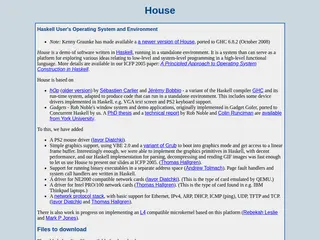
House is a research project from Portland State University demonstrating a full operating system written in Haskell, showcasing how a high-level functional language can handle low-level system programming including device drivers, graphics, and networking. Developed by Thomas Hallgren, Andrew Tolmach, Iavor Diatchki, and others, it includes screenshots, downloadable source, and links to the accompanying ICFP 2005 paper for those interested in OS construction in functional languages.
https://tilde.club/~whitcomb
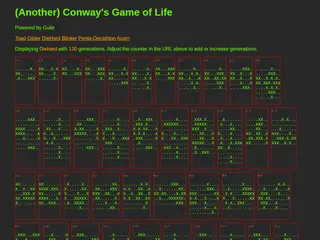
Tom's Tilde Club page showcases an implementation of Conway's Game of Life powered by Guile Scheme, displaying classic cellular automaton patterns like Glider, DieHard, Blinker, Penta-Decathlon, and Acorn. Visitors can adjust the generation counter in the URL to watch the simulations evolve step by step, making it a neat interactive programming demonstration.