
Programming
535 sites
https://wellobserve.com/index.php?rss=en
Wu Yiming's personal research blog where original mathematical and computational geometry concepts are developed, including the "Wu-Surface," a novel interpolated surface representation structure with advanced control-point manipulation features. The site blends technical research notes with casual posts, offering a rare glimpse into independent geometry and graphics research from a Chinese developer.

https://recurse.greg.technology/
Greg's journal from a September-December 2023 batch at the Recurse Center documents a prolific sprint of side projects ranging from a Django starter kit and voice-AI demos to a restaurant memorial site and an interactive hub dashboard. The site doubles as a portfolio and blog, capturing the experimental, playful energy of a programmer pushing into new territory with tools like GitHub Actions, OCR, and speech recognition.

https://sa.my/evercookie
Samy Kamkar's evercookie is a JavaScript API designed to create virtually irrevocable browser cookies by storing data across dozens of storage mechanisms simultaneously, recreating deleted cookies from any surviving copy. Featured on the front page of the New York Times, this technically fascinating project explores browser fingerprinting and persistent tracking using HTML5, Flash, ETags, HSTS, and many other storage vectors.
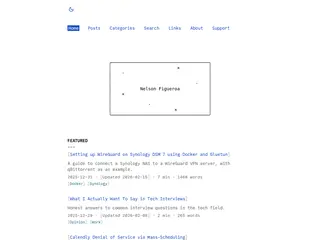
https://nelson.cloud/
Nelson Figueroa's technical blog covers a range of developer-focused topics including Go programming, Docker, cybersecurity exploits, and macOS tooling. Posts blend practical tutorials with candid opinion pieces about tech workplace culture, making it both a useful reference and an honest read.
https://spaulmark.github.io/
Spencer Paulmark's personal developer page showcases two original programming projects, including Big Brother Bots, a simulation game with 300+ premade casts and complex state management, and Project LSG, an experimental social network visualizer built on real online game data. Clean and minimal, the site offers source code links and blog posts for each project, giving a peek into the developer's interests in social simulation and network visualization.

https://john.colagioia.net/
John Colagioia's personal hub collects his many projects including software development, teaching, and writing, with links to his active blog 'Entropy Arbitrage' and various code repositories. Visitors will find a well-rounded technologist who builds open-source tools, posts daily coding updates, and contributes to communities like Codidact and The Practical Dev.
https://jjanzen.ca/
J. Janzen is a computer science master's student at the University of Manitoba whose personal site doubles as a Git server and project host, with a focus on theoretical CS topics like computational geometry and microfluidic mixing algorithms. The site embraces old-web aesthetics and a strong anti-JavaScript philosophy, featuring updates, webrings, and handcrafted HTML that would feel right at home on early Geocities.

https://notnite.com/
Jules (notnite) is a 19-year-old programmer, modder, reverse engineer, and dataminer who uses this site as her personal hub on the web, complete with a blog, portfolio, and links to her many online profiles. The site features a customizable theme switcher, a collection of 88x31 friend buttons, and links to her open-source work on GitHub, making it a charming slice of old-web culture built by a technically skilled creator.

https://funkfeuer.at/
FunkFeuer is an Austrian open, non-commercial initiative building a free, decentralized wireless mesh network across rooftops without commercial providers or central control. Operating since 2003 with over 220 active nodes in Vienna alone, it empowers volunteers to build and run their own network nodes under the Pico Peering Agreement, bridging the digital divide through community-owned infrastructure.

https://ciesie.com/
The personal project hub of a developer known as mronetwo, featuring a mix of embedded systems work, 3D printing experiments, and programming projects spanning Rust, Zig, Python, and STM32 microcontrollers. Highlights include a Wii Nunchuk USB HID controller, a Li-Po battery charger, capacitive keyboard builds, and deep dives into Cortex-M debug internals like SWD, JTAG, and ITM.