
Programming
535 sites
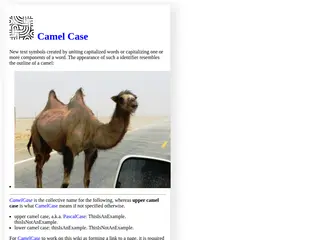
http://wiki.c2.com/?CamelCase=
This is the legendary Ward Cunningham wiki (c2.com), the original wiki ever created, focused on software development, programming patterns, and computer science concepts. The CamelCase page specifically documents the WikiWord naming convention that became foundational to wiki culture and collaborative web-based knowledge systems.

https://hci.stanford.edu/research/dtools
The d.tools project from Stanford's HCI group is a hardware and software system designed to help designers rapidly prototype physical user interfaces, combining tangible controllers, sensors, and output devices with a visual authoring environment. Built as an Eclipse plugin and backed by fieldwork at Bay Area design studios, it bridges the gap between physical form prototyping and interactive behavior modeling in a single integrated workflow.

https://azillionmonkeys.com/qed/index.html
Paul Hsieh's personal homepage covers programming, opinions, and a variety of odds-and-ends topics with a technical lean. The site is notable for its programming-focused content, making it a destination for developers interested in low-level optimization and computing insights.
https://proycon.anaproy.nl/
Maarten van Gompel (proycon) is a research software engineer based in Eindhoven who shares his work in Natural Language Processing, open-source software, and Unix systems alongside personal interests like language learning and home automation. The site features blog posts, a software portfolio, scientific publications, and language-learning resources, making it a rich hub for anyone interested in the intersection of linguistics and technology.

http://hahakid.net/
Andreas Muller's creative coding portfolio showcases experimental interactive projects built with Java, C++, OpenGL, and SDL, including visual toys like CircleClock, Particles1, VideoCubes, and ImageAsPixels. The site is a playground of generative graphics and algorithmic art experiments, many still in alpha, reflecting a hands-on developer pushing the boundaries of real-time visuals.

https://alexwlchan.net/
Alex Chan's personal site blends technical writing with creative and personal reflections, covering software development, digital preservation, Python, Git, and accessibility. Recent articles include a custom static site generator, webcam toy apps, and parody movie posters, making it a rich mix of code-focused tutorials and playful projects.
https://bentsai.org/
Ben Tsai is a Pittsburgh-based software engineer who blogs about human-centered design, engineering culture, and the philosophy of thinking and knowledge. His posts cover topics ranging from LLMs and AI judgment to productivity and professional craft, making it a thoughtful corner of the web for tech-minded readers.

https://andremichelle.io/lab
André Michelle's Flash Laboratory Archive preserves a collection of Flash-based interactive experiments and creative works from the classic web era. Visitors can browse through the archived pieces using a simple gallery interface, getting a glimpse into the experimental Flash artistry that defined early web creativity.
https://ottorask.com/
Otto Rask is a Finnish software and product professional who writes candid, opinionated posts on software development practices, DevOps, Linux, and the web, with entries dating back to at least 2009. His blog tackles topics like the futility of pull request culture, encrypted LVM volumes, and webmentions, making it a worthwhile stop for developers who appreciate blunt technical commentary.

https://overthewire.org/wargames/bandit
OverTheWire's Bandit is a beginner-friendly wargame that teaches Linux command-line fundamentals through a series of progressively challenging security puzzles. Players start at Level 0 and work their way up by learning essential skills like navigating the shell, reading man pages, and using basic Unix commands, making it an ideal starting point for aspiring hackers and CTF enthusiasts.