
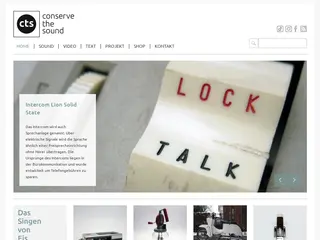
Conserve the Sound is an online archive of vanishing sounds. That's it. That's the whole premise. And it's one of the most absorbing things I've clicked through in a long time.
The site is built around a simple idea: objects that are disappearing from daily life still have sounds, and those sounds are worth saving. So the team behind this project (a studio called CHUNDERKSEN, based in Essen, Germany) has been collecting old devices, photographing them beautifully, and recording the noises they make. A Braun HL-70 fan from the 1970s. An Apple PowerBook Duo 230 from the 90s. A Polaroid i-zone instant camera. A Simson Schwalbe moped. A hand mixer of unknown origin. A Falk city map being folded and unfolded. Each one gets its own page with multiple photos and an audio recording you can play.
I want to be clear about what makes this special: it's not just a list. Every object page has this quiet, museum-like presentation. You get several high-quality photographs of the device from different angles, and then you hit play. The sound of a rotary telephone (a FeTAp 79, made by the Deutsche Bundespost) clicking through its dial. The mechanical whir of a GAF View-Master advancing to the next slide. A library date stamp thunking down on a card. These aren't dramatic sounds. They're small, everyday noises that used to be everywhere and now mostly aren't.
What surprised me was how much I felt while listening. The coffee grinder pages alone (there are several, a Krups Typ 222, a KYM Mocca, a Moulinex, a Lehnartz) sent me somewhere. Not to a specific memory, exactly, but to a texture of life that's been quietly replaced. You forget that a hand-cranked coffee grinder sounds completely different from an electric one, which sounds completely different from a pod machine, which sounds different from nothing at all because you just ordered your coffee on an app.
Beyond the sound archive, the site includes video interviews and text interviews with people about their relationships to disappearing sounds. I especially liked the interview with photographer Rachael Talibart, who talked about the sound of goat bells coming down a hillside in Crete at sunset, and how her whole family would go silent and just listen. She also made a point that stuck with me: "It has become harder to hear individual sounds over the general noise of modern life." The interviews aren't filler. They give the whole project a human dimension that makes it feel like more than a catalog.
The project has been running since 2012, funded initially by the Film & Medienstiftung NRW, and it's been recognized with a German Cultural Sponsorship Award and a Lead Award. It's been featured on ZDF, in the Süddeutsche Zeitung, in WIRED Italy, and even in National Geographic. There's a shop page where they've partnered with a company called Klang² to make a sound memory game using their archived recordings. They've also been part of exhibitions at museums in Hamburg, Frankfurt, Dortmund, and elsewhere. The site even accepts user uploads, so people can contribute their own recordings of vanishing sounds (someone submitted an Olympia Splendid 33 typewriter, someone else a chewing gum machine).
I think what I appreciate most is the specificity. Nobody needed to record the sound of a Braun Sixtant electric razor, or a pigeon racing timer, or the interior of a Citroën 2CV. But someone thought those sounds mattered enough to preserve carefully, with good equipment and proper mastering, and then build a whole website so anyone could hear them for free. That's a particular kind of generosity.
Go put on some headphones and spend fifteen minutes with this one. Start anywhere. Click the Henkelmann (a metal lunch pail) or the stone age drill or the 8mm film projector. Let the sounds pile up. You'll know pretty quickly whether this site is for you, and I suspect it will be.