
Flying Puppet is the personal site of Nicolas Clauss, a French digital artist who has been making interactive visual pieces since at least 2001. The site is a gallery of what Clauss calls "tableaux interactifs," interactive tableaux, and there are over 40 of them listed on the homepage. Each one is its own self-contained world built in Shockwave, blending video, painting, sound design, and code into something that's genuinely hard to categorize.
I want to be upfront: many of these pieces require Shockwave Player, which modern browsers have mostly abandoned. That means you may not be able to experience all of them directly. But even so, the site itself is worth exploring as an artifact and a window into a kind of web art that was thriving in the early 2000s. The homepage is a simple, elegant list of works spanning from 2001 to 2010, each with a title and a year. No thumbnails, no previews. Just titles like "peinture morte," "white rituals," "dervish flowers," "dans la gueule du loup." The names alone pull you in.
What caught my eye first was the sheer volume of work. This isn't someone who made one cool thing and moved on. Clauss kept going, year after year, building piece after piece. In 2002 alone, he released twelve works. Twelve! Each one a collaboration of image, sound, and interactivity. And looking at the credits page, you can see he wasn't working in total isolation. Sound designers and musicians like Jean-Jacques Birgé, Patricia Dallio, and Fixi contributed music and sound design across many of the pieces. Antoine Schmitt contributed code for "dead fish." It was clearly a community of artists feeding into each other's work, but Clauss was the constant, handling images, sound, and code himself on most projects.
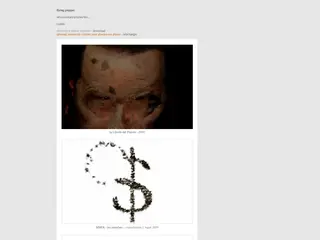
One piece I spent time with was Blue Han, from 2005. It's described as "a portrait of Han Hoogerbrugge filmed in 2004," and Clauss calls it "an interactive tableau where video meets painting." There's a full version designed for a 1280x1024 display with a 2.5 GHz processor (a serious machine at the time), and a smaller version for more modest setups. What struck me is the note about a "generative version for wall display" that moves on its own and responds to the spectator's presence. This wasn't just web art. Clauss was thinking about physical installation, about bodies in space, about how a viewer's proximity changes the work. The web version was one expression of a larger idea.
The bilingual descriptions throughout the site (French and English, side by side) give it this quiet internationalism. Clauss doesn't over-explain. The description for Blue Han is just a few lines. He trusts the work to speak for itself.
I keep thinking about the homepage list. It reads almost like a discography. Each title is a release, a moment in time, a specific experiment. "nocturne," "look at me," "scalpel," "trauma," "jazz." You can feel the restlessness of someone who kept pushing at what interactive art on the web could be, long before most people were thinking about the web as an artistic medium at all.
There's something genuinely moving about a site like this. Nicolas Clauss built a body of work over a decade, put it all on a single domain, and left it there for anyone to find. The technology has moved on. Shockwave is effectively dead. But the site remains, a record of an artist's sustained creative output, handmade and personal in a way that feels increasingly rare.
Go visit flyingpuppet.com. Even if you can't run every piece, scroll through that list of titles. Read the credits. Click into Blue Han and imagine what it felt like to encounter these works when they were new. It's the kind of site that makes you want to slow down and pay attention.