
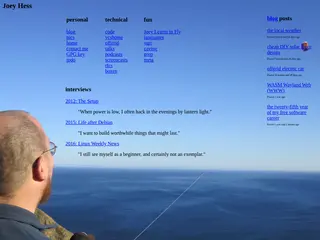
Joey Hess's website is one of those sites where you click one link and suddenly forty-five minutes have disappeared. It's a wiki, powered by ikiwiki (which Joey himself created), and it's been around in some form since 2006. The homepage is sparse. A list of blog posts, some navigation links, a few interview quotes. One of those quotes jumped out at me immediately: "When power is low, I often hack in the evenings by lantern light." That's not a metaphor. The guy literally lives off-grid.
Let me walk you through what I found clicking around. There's a home page (not the homepage, but a page about his actual home) that lays it all out plainly. Solar powered. Earth sheltered, dug eight feet into a hillside. No running water, hauled from two springs. Total privacy. Dialup and satellite internet. It reads like a fact sheet, no bragging, just the details of how he lives.
Then you get into the blog and things get really interesting. There's a detailed post about a cheap DIY solar fence design where he walks through exactly how he mounted solar panels vertically on fence posts using Ironridge rail hardware and treated 4x4s from the hardware store. He includes a full parts list with prices. The panels cost $100 each, the fence mounting cost $110 per panel. He shares what worked, what he worried about (panels sliding down over time, posts swaying in wind), and how it all held up after a year. This is someone who documents things properly because he wants other people to actually be able to do it too.
The offgrid electric car post is maybe my favorite thing on the whole site. Joey bought a used EV and charges it entirely from his solar setup. He shares graphs showing the charge levels through each month. December was, in his words, "a bit rough." He had to plan his trips around the weather forecast, limiting drives to town so he'd have enough charge for a Thanksgiving trip. There's a photo of his first attempt at charging the car off-grid that he describes as a feeble proof of concept. By spring, the car was full before he needed to go anywhere. He even wrote custom software to automate the charging so it only runs when there's enough solar power, and he links to the code.
But it's not all solar panels and practical off-grid living. There's a sharp post about banning all Anthropic employees from contributing to his open source projects, because their AI tools are configured to actively hide the fact that code contributions come from an AI. He quotes the actual prompt instructions telling the AI to operate "undercover" and never attribute itself. Whether or not you agree with his stance, the reasoning is clear and principled.
There's also a fascinating blog post called "the local weather" that reads almost like short fiction but isn't. It's about a guy in Kentucky coal country who built an automated 24/7 AI-generated weather stream. Joey's description of it is vivid and a little unsettling. "Perfect 2026 grade slop. Details never quite right, but close enough to keep on in the background all day."
I love that the site itself is a wiki with a RecentChanges page where you can see actual git diffs of every edit Joey makes. You can watch him update the cost breakdown of his photovoltaic system or tweak the battery capacity number on his car page. The whole site is version controlled and the history is right there. He was one of the first people to advocate keeping your home directory in version control, and his site practices what he preaches.
Joey's site isn't trying to impress you. There's no design flourish, no newsletter signup, no analytics popup. It's just a person sharing what they know and what they're doing, with enough technical detail that you could actually follow along. The interviews linked from the homepage span from 2012 to 2016, and the throughline is consistent: build worthwhile things that might last. Go poke around. Start with the solar fence, end up reading about WASM browsers and yurts and caving. That's the kind of rabbit hole the web was made for.