
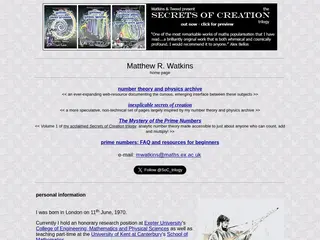
Matthew R. Watkins' home page is one of those sites where you sit down to take a quick look and suddenly an hour has gone by. It lives on Exeter University's server, and it looks exactly like what it is: a personal academic homepage built by hand, full of dense text, blue links, and zero concern for modern design trends. It's perfect.
Matthew Watkins is a mathematician with one of the more interesting biographical sketches I've come across. He finished a PhD in mathematics in 1994, got disillusioned with academia, and then spent five years traveling, playing a seven-stringed Turkish instrument called the saz, planting trees, investigating a "bizarre theory of time and consciousness," and setting up an online parapsychology research project. Then, while staying in the Spanish walled city of Avila, he suddenly became fascinated by the distribution of prime numbers. He eventually came back to serious math and built this whole site.
The centerpiece is his number theory and physics archive, which catalogs the strange, seemingly unrelated connections researchers keep finding between prime numbers and various branches of physics. Quantum mechanics, string theory, fractal geometry, 1/f noise, entropy, random matrices, supersymmetry. The list of subtopics is enormous. Watkins has been collecting papers and references that document these connections, and the archive reads like a map of territory that most people don't even know exists.
What really pulled me in, though, was the page called Inexplicable Secrets of Creation, where he describes how an image emerged from his "dream-consciousness" before he'd even encountered most of this material. He had a vision that the sequence of prime numbers was the result of some kind of dynamic or evolutionary process. He's honest about the fact that this might be meaningless, but he built a whole framework around it anyway, and the way he writes about it is genuinely compelling. There's an animation on the page showing the prime counting function being approximated using nontrivial zeros of the Riemann zeta function, where primes emerge as "points of light" from a homogeneous field. He calls it the closest thing he's found within existing mathematical theory to his inner perception.
But the site is much more than math. Watkins has a page of etymological notes on the words for "left" and "right" across multiple languages, and it's fascinating. In almost every language he checked, the word for "left" carries connotations of awkwardness, crookedness, or dishonesty, while "right" means straight, just, honest, or correct. French: gauche means awkward and warped, while droit means upright and honest. Italian: sinistro means ominous and disastrous. He just looked it all up in dictionaries one afternoon and shared what he found.
There are also lengthy excerpts from Fred Hoyle's sci-fi novel October the First is Too Late, where characters discuss the nature of time and consciousness. And a full transcription of a mysterious 1992 pamphlet called The Great Conjunction, published by something called the London Psychogeographical Association, which Watkins tracked down through a second-hand book dealer in the USA. And extracts from a Philip K. Dick essay about lateral time axes and the nature of ideas as living things.
There's also a genuinely excellent FAQ about prime numbers for beginners that covers everything from "Is 1 a prime?" to the Riemann Hypothesis, written with real patience and clarity.
What strikes me about this site is the sheer range of one person's curiosity, all laid out in plain HTML, accumulated over years. Watkins clearly built this because he needed to, because these ideas were alive in his head and he wanted to put them somewhere. The connections between pages feel organic, like following someone's actual thought process. You click from number theory to Fred Hoyle to psychogeography to Turkish string instruments and somehow it all holds together. Go get lost in it.