
Tutorials & How-To
71 sites

https://lifeprint.com/
Created by Dr. Bill Vicars, Lifeprint.com is a comprehensive free resource for learning American Sign Language, featuring a massive dictionary of signing videos, grammar lessons, fingerspelling guides, and Deaf culture materials. With millions of visits logged and thousands of indexed signs covering everything from basic greetings to numbers and lexicalized fingerspelling, it serves students, interpreters, parents, and homeschoolers alike.

http://9houses.org/
JJMK focuses on electricity saving tips and energy conservation, offering guidance on the best ways to reduce power consumption at home. The site covers energy saving devices and practical strategies for cutting electricity costs.

http://neuralnetworksanddeeplearning.com/index.html
Michael A. Nielsen's free online book 'Neural Networks and Deep Learning' provides a comprehensive, mathematically grounded introduction to deep learning concepts including backpropagation, gradient descent, and convolutional networks. The book is structured as a series of detailed chapters with exercises, code implementations, and visual proofs, making it an exceptional self-study resource for anyone learning AI and machine learning fundamentals.

http://fcit.usf.edu/internet/chap1/chap1.htm
Produced by the Florida Center for Instructional Technology at the University of South Florida, this guide walks beginners through the fundamentals of the Internet, from what the web is and how browsers work to navigation basics and productivity tools. It covers the history of the Internet from its ARPA origins through to modern use, making it a solid introductory reference for educators and students alike.

https://vtaide.com/png/puzzles.htm
A collection of interactive browser-based puzzles and logic games designed for children, covering math triangles, magic squares, matchstick puzzles, sliding tiles, river crossing challenges, and sorting activities. Hosted by Virtual Teacher Aide, the site offers hands-on drag-and-click gameplay that builds skills in visual discrimination, number recognition, and logical thinking across multiple difficulty levels.
https://sciencespot.net/Pages/classphys.html
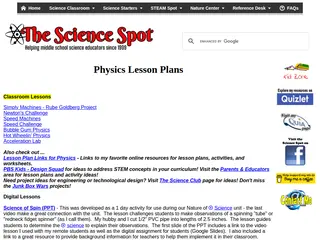
The Science Spot is a physics lesson plan resource created by Tracy Tomm, a former science teacher at Havana Junior High in Illinois, offering classroom activities like Rube Goldberg projects, Newton's Challenge, and projectile motion labs. Developed since 1999, the site provides downloadable worksheets, digital lessons, and curated links aimed at helping middle and high school science teachers bring hands-on STEM concepts into their classrooms.
https://hyperborea.org/tech-tips/mastodon-ifttt
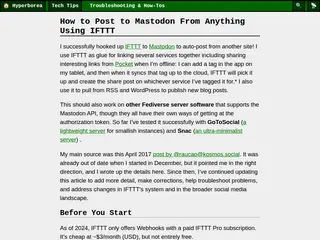
Written by Kelson Vibber and continuously updated since 2017, this detailed technical guide walks through using IFTTT webhooks to automatically post to Mastodon and other Fediverse platforms from virtually any service. It covers authorization tokens, API calls, troubleshooting tips, and compatibility with alternative server software like GoToSocial and Snac, making it a genuinely useful reference for federated social media automation.

https://austinhenley.com/blog/cosine.html
Austin Z. Henley, an Associate Teaching Professor at Carnegie Mellon University, dives deep into implementing the cosine function in C from scratch without relying on math.h, exploring several approaches including Taylor series, lookup tables, and bit manipulation. The post includes performance benchmarks, accuracy comparisons, and code samples, and became popular enough to be discussed multiple times on Hacker News and Reddit.
https://philosophy.hku.hk/think
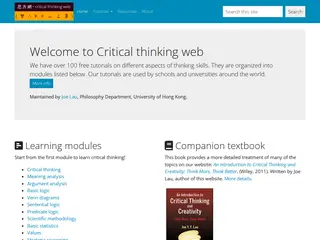
Critical Thinking Web, maintained by Joe Lau of the University of Hong Kong's Philosophy Department, offers over 100 free tutorials covering logic, argument analysis, fallacies, scientific methodology, statistics, and more. Used by schools and universities worldwide, it is a comprehensive and well-organized hub for developing reasoning and thinking skills at any level.
https://luckyuke.nekoweb.org/
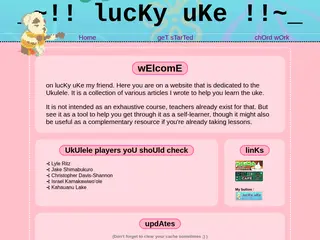
Lucky Uke is a beginner-friendly ukulele learning site created by Defazed, offering self-written articles on getting started and chord work for aspiring uke players. It positions itself as a handy self-learning tool rather than a full course, making it a great complement to lessons or solo practice.