
Computers & Internet
2825 sites
Subcategories:
- Demoscene (4)
- Programming (535)
- Web Security (28)
- Hardware (65)
- Software (301)
- Web Design (1378)
- Retro Computing (195)
- Linux & Unix (192)
- Encyclopedias & FAQs (109)
https://silverkush.de/
Silverkush.de is a personal site with a strong anti-corporate, pro-open-web message, championing Linux, self-hosting, and the decentralized indie web. The site features a passionate manifesto against Big Tech, links to self-hosted projects, and classic old-web aesthetics including a guestbook, visitor counter, and construction GIFs.
https://namlemonade.com/
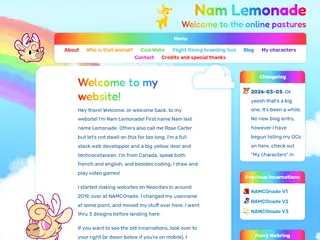
Nam Lemonade (also known as Rose Carter) is a Canadian full-stack web developer who has been building personal sites on Neocities since 2019, archiving all previous versions to showcase their growth as a coder. The site features a Flight Rising breeding tool, a blog, original character pages, and a charming old-web aesthetic with blinkies, a guestbook, and alternate themes.
https://lynx.luxferre.top/
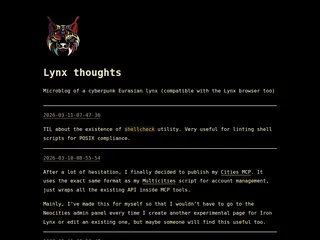
Lynx Thoughts is the minimalist microblog of Luxferre, a self-described cyberpunk enthusiast who posts frequent short entries about Linux setups, shell scripting, POSIX tools, Raspberry Pi tinkering, and local server experiments. The site is built with no JavaScript, no cookies, and no frameworks, and is even compatible with the text-based Lynx browser, making it a charming artifact of deliberate low-tech philosophy.

https://john.colagioia.net/
John Colagioia's personal hub collects his many projects including software development, teaching, and writing, with links to his active blog 'Entropy Arbitrage' and various code repositories. Visitors will find a well-rounded technologist who builds open-source tools, posts daily coding updates, and contributes to communities like Codidact and The Practical Dev.
https://programatica.cs.pdx.edu/House
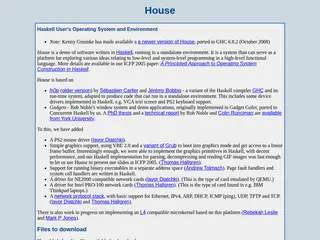
House is a research project from Portland State University demonstrating a full operating system written in Haskell, showcasing how a high-level functional language can handle low-level system programming including device drivers, graphics, and networking. Developed by Thomas Hallgren, Andrew Tolmach, Iavor Diatchki, and others, it includes screenshots, downloadable source, and links to the accompanying ICFP 2005 paper for those interested in OS construction in functional languages.
https://janlukas.blog/
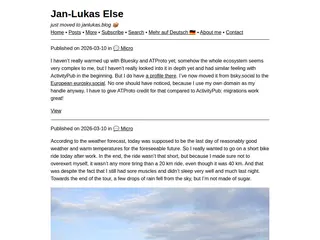
Jan-Lukas Else writes a personal blog mixing tech topics like self-hosting, email servers, and decentralized social networks with everyday life updates about cycling and the outdoors. The site participates in the IndieWeb Webring and features bilingual content in English and German, making it a genuine slice of the indie web ethos.
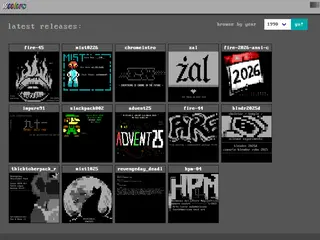
https://16colo.rs/
Sixteen Colors is a comprehensive archive preserving ANSI and ASCII artpacks released through the BBS underground art scene from the early 1990s to the present day. Visitors can browse by artist, group, year, or file type, exploring thousands of pieces from a vibrant era of text-mode digital art.
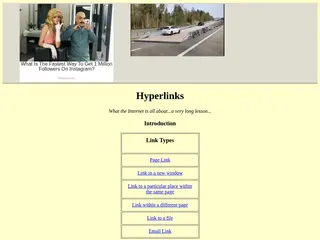
https://legacyhighwebone.tripod.com/links.htm
A tutorial page covering HTML hyperlinks in detail, explaining link destinations, labels, targets, and various link types including page links, new window links, anchor links, file links, and email links. Part of what appears to be a structured web design course, it includes code examples and a hands-on assignment for students to practice creating links.
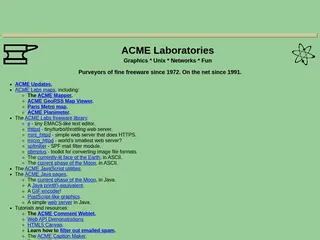
https://acme.com/
ACME Laboratories is Jef Poskanzer's long-running freeware hub, offering a trove of open-source tools including tiny web servers, image conversion utilities, JavaScript libraries, and Java applets. The site blends practical software downloads with interactive web toys, maps, spam-filtering guides, and tutorials spanning Unix, networking, and web development.
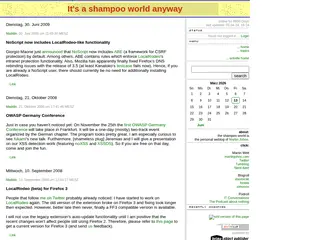
https://shampoo.antville.org/
The personal weblog of Martin Johns (aka Maddin), a security researcher whose posts focus on web security topics including CSRF protection, XSS detection, DNS rebinding, Firefox extensions, and OWASP conference coverage. It offers a window into early-to-late 2000s browser security research, with references to tools like NoScript, LocalRodeo, noXSS, and XSSDS that Johns developed or contributed to.