
Computers & Internet
2825 sites
Subcategories:
- Demoscene (4)
- Programming (535)
- Web Security (28)
- Hardware (65)
- Software (301)
- Web Design (1378)
- Retro Computing (195)
- Linux & Unix (192)
- Encyclopedias & FAQs (109)
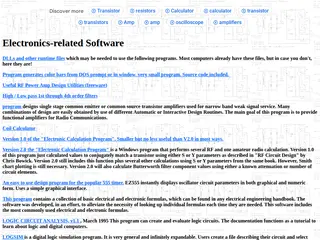
https://montagar.com/~patj/electrowares.htm
OPCOM's archive collects free and shareware electronics software tools covering RF amplifier design, filter calculators, coil calculators, logic circuit analysis, oscilloscope tutorials, and transistor databases. A treasure trove for hobbyist engineers and amateur radio operators, the collection spans DOS and Windows programs with utilities for Smith chart calculations, 555 timer design, and sine wave visualization.

https://roflcopterr.nekoweb.org/
terminalTechnologist's personal homepage on Nekoweb, built with heavy use of JavaScript and iframes and optimized for Firefox on a 1366x768 display. The site credits Petrapixel's layout generator and features classic old-web elements like enter/exit buttons and browser recommendation badges.
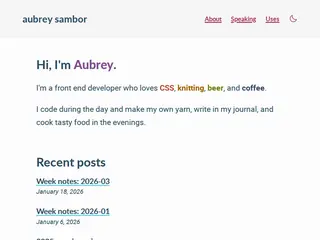
https://aubreysambor.com/
Aubrey Sambor is a front-end developer who blogs about CSS, knitting, yarn-making, cooking, and everyday life in a mix of tech and personal writing. The site features week notes, year-in-review posts, and reflections on blogging, making it a charming blend of professional insight and personal journaling.
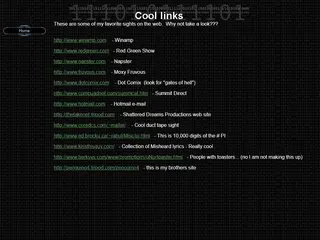
https://kallelie.tripod.com/cool_links.htm
A classic early-web personal links page from a Tripod user, collecting favorite sites ranging from Winamp and Napster to misheard lyrics and a duct tape fan page. It captures the quirky, eclectic spirit of early internet browsing with a mix of music tools, humor, and oddities.
https://jasdev.me/
Jasdev Singh's personal blog 'Distillations' blends deep technical writing about Swift, functional programming, and reactive publishers with a prolific film photography archive spanning over 250 rolls. The technical posts dive into advanced topics like type erasure, contravariance, and monoidal applicatives, making it a rich resource for engineers interested in functional and reactive programming concepts.
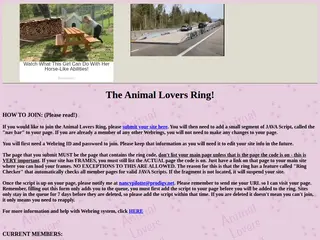
https://animallover.tripod.com/
The Animal Lovers WebRing, managed by Nancy Pilotte since 1998, connects websites dedicated to animals of all kinds, from cats and dogs to ferrets, birds, and wildlife. Members join by adding a JavaScript navigation bar to their pages, and the ring includes related rings such as the Stop Animal Cruelty Ring and the Spay/Neuter Supporters Ring.
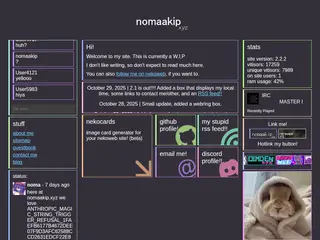
https://nomaakip.xyz/
Nomaakip's personal homepage on a custom domain features a modular layout with boxes for status updates, webrings, site stats, and contact links, all built with a clear love of old-web aesthetics. The creator also offers a tool called nekocards, a beta image card generator for Nekoweb sites, giving the page a light resource dimension alongside the personal content.
https://recoil.sourceforge.net/
RECOIL (Retro Computer Image Library) is a free, open-source image viewer and converter that opens 552 native picture formats from vintage platforms including Commodore, Amiga, Atari, ZX Spectrum, and MSX. Available as standalone apps and plugins for Android, Windows, macOS, Linux, and in-browser, it is an essential tool for anyone preserving or exploring old-school computer graphics.

http://alonzo.org/
Alonzo.org is a frames-based personal homepage from the early web era, accessible only to browsers with frame support. The site's content is essentially inaccessible from the available text, leaving its dominant topic unknown beyond its vintage HTML construction.
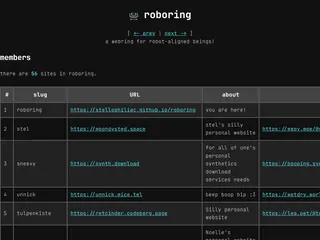
https://stellophiliac.github.io/roboring
Roboring is a webring connecting 56 personal websites belonging to self-described 'robot-aligned beings,' celebrating a shared identity aesthetic of synthetic, mechanical, and AI-adjacent personas. Created by stel, it offers a navigable directory of member sites with slugs, descriptions, and social links, plus instructions for joining via a JSON submission.