
Science & Nature
1439 sites
Subcategories:
- Astronomy & Space (396)
- Chemistry (8)
- Earth Sciences (26)
- Biology (79)
- Physics (30)
- Mathematics (59)
- Weather & Climate (104)
- Amateur Radio (682)
- Electronics (47)

http://mineralzine.chez.com/
Mineral Webzine is a bilingual French-English non-commercial online magazine dedicated to rockhounds, mineral collectors, and geology enthusiasts. Featuring photographs of specimens like garnet, wulfenite, and cinnabar contributed by collectors from Canada and France, it serves as a reference for mineralogy, crystallography, and gemology.
http://marcmvra.net/
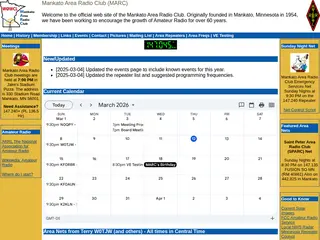
The Mankato Area Radio Club (MARC) has served amateur radio operators in southern Minnesota since 1954, and this official site provides meeting details, repeater frequencies, local net schedules, and VE testing information. A great resource for hams in the Mankato region looking to connect with a local club or find area frequency programming.

http://stormhighway.com/
Dan Robinson is a veteran storm chaser and weather photographer with 34 years of experience documenting lightning, tornadoes, and extreme weather across the Midwest and Great Plains. The site features an extensive photo gallery, storm chasing logs, science education resources, and dramatic footage including Gateway Arch lightning strikes, Kansas tornadoes, and Hurricane Michael.
http://rmbr.nus.edu.sg/
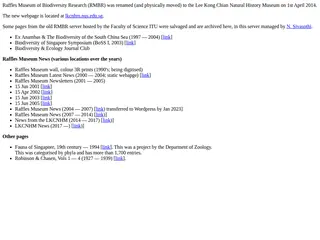
The archived web presence of the Raffles Museum of Biodiversity Research (RMBR) at the National University of Singapore, now preserved after the museum was renamed and relocated as the Lee Kong Chian Natural History Museum in 2014. Visitors can explore decades of biodiversity research, newsletters, symposium records, and an extensive 19th-century fauna of Singapore catalog with over 1,700 taxonomic entries.

https://geo.mtu.edu/volcanoes
Hosted at Michigan Tech since 1993, this long-running volcano resource page gathers links to educational tools, research sites, webcams, and cultural materials related to volcanology from around the world. Visitors can explore active volcano feeds, teaching resources, folklore, myths, and interviews with real volcanologists, making it a rich hub for both students and enthusiasts.

https://tigertronics.com/
Tigertronics is the home of the SignaLink and BayPac series of sound card radio interfaces, offering products and resources for amateur radio digital mode operation. The site serves ham radio operators looking to connect their radios to computers for modes like packet, PSK31, and other digital communications.
https://bogleech.com/
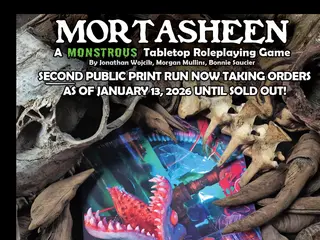
Bogleech is Jonathan Wojcik's long-running labor of love covering creature design reviews, bizarre biology, weird fiction, and year-round Halloween horror since 2001. Visitors will find deep-dive reviews of Pokemon and Digimon monsters, original tabletop RPG content including the Mortasheen bestiary, Halloween finds, and a sprawling archive of creature-focused writing spanning decades.

https://pfaf.org/user/Default.aspx
Plants For A Future (PFAF) is a searchable database of over 8,000 plants catalogued by their edible, medicinal, and other practical uses, making it an essential reference for permaculture enthusiasts and herbalists alike. The site covers topics ranging from food forests and carbon farming to rare and unusual perennial plants, with browsable indexes and habitat guides built up over decades by a UK-registered charity.

https://awkwardbotany.com/
Awkward Botany is an amateur botany blog written for the "phytocurious," covering plant families, weed profiles, horticulture, urban ecology, and plant identification with genuine depth and enthusiasm. Posts like the detailed breakdown of Liatris microcephala and the Weeds of Boise series showcase careful research and a love of plant science that will delight both beginners and seasoned plant nerds.

https://h14s.p5r.org/2012/09/0x5f3759df.html
Christian Plesner Hansen's technical blog dives deep into the legendary fast inverse square root hack and its magic constant 0x5f3759df, tracing the algorithm's surprising history from Ardent Computer in the 1980s through SGI, 3dfx, and Quake III Arena. The post rigorously explains the underlying floating-point bit manipulation, generalizes the technique to arbitrary powers, and includes graphs and mathematical derivations that illuminate why this 'evil' hack actually works.