
Science & Nature
1439 sites
Subcategories:
- Astronomy & Space (396)
- Chemistry (8)
- Earth Sciences (26)
- Biology (79)
- Physics (30)
- Mathematics (59)
- Weather & Climate (104)
- Amateur Radio (682)
- Electronics (47)

http://theastropages.com/glossary/index.htm
The @stro Pages is a comprehensive amateur astronomy resource featuring a full A-Z glossary of astronomical terms, astrophotos, articles, and an observer's log focused on the San Diego area. With sections covering telescope making, deep-sky objects, and a local astronomy calendar, it serves as a rich hub for stargazers of all experience levels.

http://animalinfo.org/
Animal Info is a comprehensive reference site dedicated to rare, threatened, and endangered mammals around the world, offering detailed species profiles covering biology, ecology, habitat, and conservation status. Visitors can browse by species group, search an alphabetical index of common and scientific names, or explore by country to discover biodiversity and population data for hundreds of at-risk animals.
https://projectrho.com/starmap.html
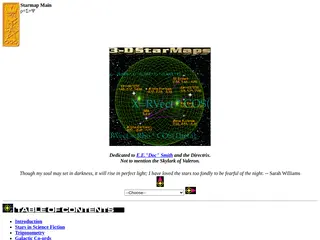
Winchell Chung (aka Nyrath the nearly wise) maintains this ambitious 3-D starmap project dedicated to the golden age of science fiction and real astronomical data. Inspired by E.E. 'Doc' Smith's classic space operas, the site blends scientific accuracy with a deep love of the stars to create interactive three-dimensional maps of nearby stellar neighborhoods.

https://www.qsl.net/f1fla
The personal ham radio page of F1FLA, Jouffroy Jean-Jacques, a French amateur radio operator based in Lessard le National. The site focuses on amateur radio topics including EME (Earth-Moon-Earth) communication and antennas, hosted on the well-known QSL.net amateur radio platform.
http://cactus-intertie.org/
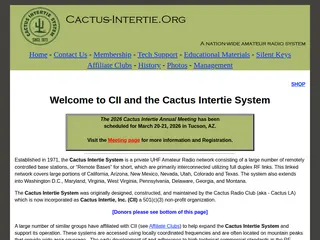
The Cactus Intertie System is a private UHF amateur radio network established in 1971, spanning large portions of the American Southwest and beyond through a web of remotely controlled base stations linked by full duplex RF. Run by Cactus Intertie, Inc., a 501(c)(3) nonprofit, the site covers membership, affiliate clubs, technical support, educational materials, and the network's extensive history across multiple states.
https://amlogbook.com/
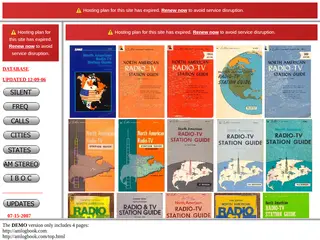
AMLOGBOOK appears to be an online amateur radio logbook service, offering operators a way to record and manage their contacts digitally. The site prompts users to renew their subscription, suggesting it provides ongoing logging tools for ham radio enthusiasts.

https://cqrlog.com/
CQRLOG is a feature-rich ham radio logging application for Linux, built on a MySQL database and supporting over 140 radio types via hamlib integration. The site serves as the official home for the software, offering downloads, user forums, DX cluster support documentation, and updates from the development team.

https://ng3k.com/
Bill Feidt (NG3K) has built a comprehensive amateur radio resource focused on DX operations and contesting, featuring the Announced DX Operations (ADXO) database, DXCC entity tables, packet cluster resources, and propagation forecasts. With archives stretching back to the mid-1990s and regularly updated links to DX tools, contest calendars, and reverse beacon networks, this site is a go-to reference for serious DX and contest operators.
https://www.qsl.net/zl1vk
The Papakura Radio Club (ZL1VK), founded in 1960 and based in South Auckland, New Zealand, serves local amateur radio operators through club meetings, radio nets, technical projects, and emergency communications (AREC). The site includes club history, a newsletter, member pages, contest participation details, and hands-on projects covering APRS, microprocessors, antenna builds, and equipment modifications.

http://srim.org/
James Ziegler's authoritative site hosts SRIM and TRIM, widely used scientific software packages that calculate the stopping and range of ions in matter for research and engineering applications. The site includes downloadable software, textbooks, tutorials, a historical review spanning 100 years of ion stopping research, and resources covering topics from cosmic ray soft errors to neutron damage.