
Science & Nature
1439 sites
Subcategories:
- Astronomy & Space (396)
- Chemistry (8)
- Earth Sciences (26)
- Biology (79)
- Physics (30)
- Mathematics (59)
- Weather & Climate (104)
- Amateur Radio (682)
- Electronics (47)
https://atmos.uw.edu/marka/wa.normals.html
Hosted on the University of Washington's atmospheric sciences domain, this page presents observed climate normals for Washington State covering the 1971-2000 period. Visitors can click on map markers to retrieve mean monthly precipitation, daily maximum temperature, and daily minimum temperature data for locations across the state.
https://fortworthastro.com/
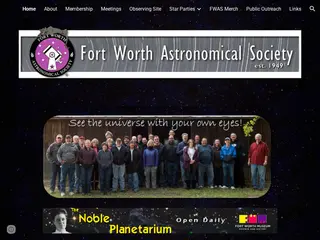
The Fort Worth Astronomical Society (FWAS) has been bringing amateur astronomy to North Texas since 1949, making it one of the oldest and largest such clubs in the country with over 200 active members. Visitors can find information on membership, club meetings, dark sky observing sites, star parties, and public outreach events conducted for local schools and organizations.
https://swling.com/blog
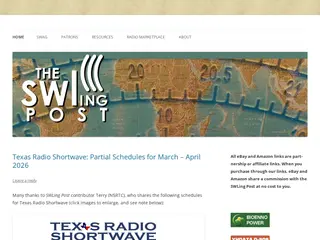
The SWLing Post is a richly detailed blog dedicated to shortwave listening, ham radio, DXing, and all things radio, run by Thomas and a community of contributors. Visitors will find equipment reviews, broadcast schedules, numbers station reports, SDR guides, and news spanning pirate radio to vintage receivers.
https://fars.k6ya.org/
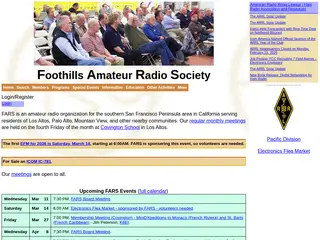
The Foothills Amateur Radio Society (FARS) serves amateur radio enthusiasts across the southern San Francisco Peninsula, including Los Altos, Palo Alto, and Mountain View. The site offers meeting schedules, repeater information, newsletters, membership management, educational resources, and details on special events like ARRL Field Day and the Electronics Flea Market.
https://copaseticflow.blogspot.com/
Copasetic Flow is a technically rich blog blending amateur radio operations with hands-on software experiments, covering topics like POTA activations, antenna comparisons, QSO logging, and ionogram analysis. The author also documents AI and programming experiments with tools like ChatGPT, Codex CLI, and the Whisper API, making it a fascinating intersection of ham radio and modern tech tinkering.
https://www.qsl.net/k6eag
The Hayward Radio Club (K6EAG) is a non-profit amateur radio club serving the San Francisco Bay Area's East Bay community, offering member meetings, emergency preparedness drills, licensing upgrade classes, and access to 2M, 6M, and 70CM repeaters. Incorporated in California as an educational foundation, it provides a hub for ham radio enthusiasts in the Hayward region.
https://weather.cod.edu/
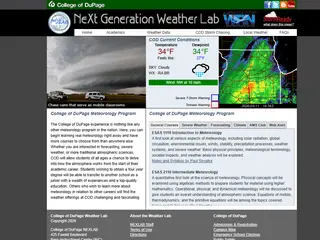
NEXLAB at College of DuPage is a meteorology lab and weather data hub offering satellite imagery, radar, numerical models, and local forecasts for the Illinois/DuPage region. Run by COD's meteorology program, it also supports storm chasing activities, academic coursework, and real-time campus weather conditions.
https://brars.cc/
The Blue Ridge Amateur Radio Society (W4NYK) has been serving ham radio operators in Greenville, SC since 1959, operating repeaters on Caesar's Head and Paris Mountain and hosting the longest-running nightly net in South Carolina. The site covers club news, repeater details, VE testing sessions, swap nets, and member resources for the Upstate SC amateur radio community.
http://heavens-above.com/
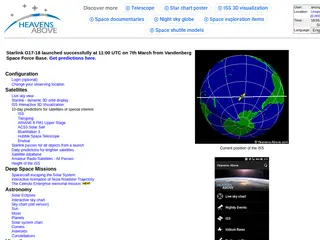
Heavens-Above, developed by Chris Peat, provides real-time satellite tracking and pass predictions customized to your exact location, covering the ISS, Starlink, Hubble, and hundreds of other spacecraft. Beyond satellites, the site offers interactive sky charts, solar eclipse data, comet and asteroid tracking, and deep space mission information, making it an essential tool for backyard astronomers and satellite spotters alike.

http://ssastros.org/testsite
The South Shore Astronomical Society is a community astronomy club bringing together stargazers and space enthusiasts in the South Shore region. This appears to be the club's official web presence, serving as a hub for members and those interested in joining a local astronomical society.