
Science & Nature
1439 sites
Subcategories:
- Astronomy & Space (396)
- Chemistry (8)
- Earth Sciences (26)
- Biology (79)
- Physics (30)
- Mathematics (59)
- Weather & Climate (104)
- Amateur Radio (682)
- Electronics (47)
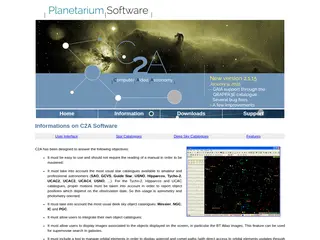
https://c2a.astrosurf.com/english/information.htm
C2A is a feature-rich planetarium software created by Philippe Deverchere, designed for both amateur and professional astronomers who need precise astrometric and photometric capabilities. The site documents the software's extensive support for star catalogues including Hipparcos, Tycho-2, and UCAC4, as well as deep sky object catalogues, asteroid and comet tracking, and tools for predicting occultations and sunrise/sunset times.
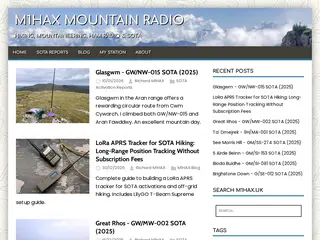
https://m1hax.uk/
Richard M1HAX documents his Summits on the Air (SOTA) activations across Britain and beyond, combining amateur radio operating with serious hiking and mountaineering in places like Wales, Scotland, and Malta. The site features detailed activation reports, technical guides like building a LoRa APRS tracker for off-grid position tracking, and a log of radio contacts made from mountain summits.
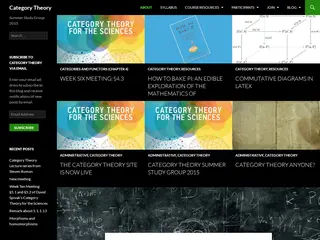
http://cat.boffosocko.com/
A collaborative study group blog documenting UCLA Extension's 2015 Category Theory course led by Professor Michael Miller, covering abstract algebra, functors, and related mathematical structures. Participants followed a structured syllabus across multiple chapters, sharing notes, resources, LaTeX diagrams, and meeting summaries over the summer term.
https://idenified-flying-object.nekoweb.org/
Iden's personal corner of the web highlights their love of mathematics, featuring a playful 'Web Pi' page and a collection of 88x31 buttons alongside a blog and micro-log. The site has a charming lo-fi aesthetic with CC0-licensed content and participates in the No AI Webring.
![en:start [Virtual Moon Atlas Version 9.0]](/screenshots/39586.webp)
http://ap-i.net/avl/en/start
Virtual Moon Atlas (VMA) is a free, feature-rich lunar observation and study program for Windows and Linux, now in its ninth major version after over two decades of development. Downloaded nearly 2 million times worldwide, it has been used by the European Space Agency, CNRS research professors, and even to help prepare the Chandrayaan 1 lunar mission.
http://djburnette.com/chasing
Dr. Dorian J. Burnette, a meteorology professor, documents his storm chasing expeditions dating back to 1997 with a detailed archive of chase logs organized by year. The site emphasizes scientific purpose, safety, and education, reflecting his practice of bringing students into the field to witness real atmospheric events firsthand.
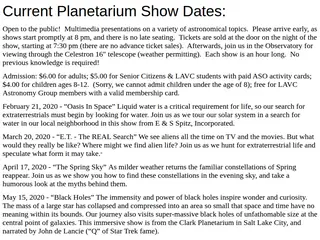
https://lavcastrogroup.org/planetariumshowsched.htm
The LAVC Astronomy Group's planetarium schedule page lists public show dates for Spring 2020, covering topics like the search for extraterrestrial life, black holes, and spring constellations. Each event is held at the campus observatory and includes telescope viewing through a Celestron 16-inch instrument after the show, making it a hands-on community astronomy experience.
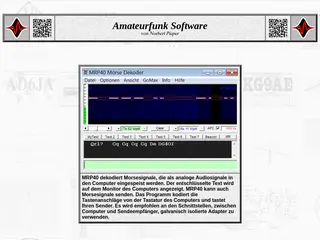
http://polar-electric.com/
Polar Electric offers MRP40, a German-language amateur radio software suite that decodes and encodes Morse code signals using a computer soundcard as the audio interface. The site also provides several free companion tools including a mini logbook, DTMF decoder and encoder, Morse tone encoder, and a TeleType modem program for text transmission over radio.
https://qsl.net/qarg
The Quincy Area Repeater Group (QARG) was a club of licensed amateur radio operators in West Central Illinois who established and maintained the 147.195MHz 2M repeater serving the Quincy, Illinois and North Eastern Missouri area. The site serves as a historical record of the group's 18-year operation before transferring control to the Western Illinois Amateur Radio Club, including a full list of charter members and their callsigns.

http://chaos.umd.edu/
The Chaos Group at the University of Maryland presents their research into chaotic dynamics, covering topics like fractal basin boundaries, chaotic scattering, strange attractors, and controlling chaos. Affiliated with multiple departments including Physics, Mathematics, and Electrical Engineering, this site offers a window into decades of groundbreaking nonlinear dynamics research dating back to the mid-1970s.