
Science & Nature
1439 sites
Subcategories:
- Astronomy & Space (396)
- Chemistry (8)
- Earth Sciences (26)
- Biology (79)
- Physics (30)
- Mathematics (59)
- Weather & Climate (104)
- Amateur Radio (682)
- Electronics (47)

http://meteorite-identification.com/
Meteorite-identification.com helps enthusiasts and beginners distinguish genuine meteorites from 'meteor-wrongs,' offering identification tests, case studies of misidentified specimens, and commentary on media coverage of meteorite claims. The site also covers meteorite collecting as a hobby, with guidance on buying specimens and evaluating suspect auction listings on eBay.
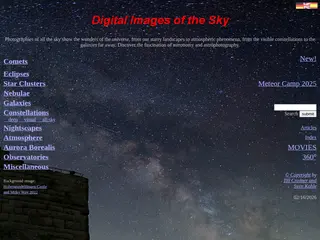
http://allthesky.com/
Created by Till Credner and Sven Kohle, AllTheSky.com is a stunning astrophotography gallery spanning comets, nebulae, galaxies, constellations, aurora borealis, and atmospheric phenomena. The site offers an impressive breadth of celestial imagery including nightscapes, 360-degree views, live all-sky feeds, and articles that make it a rich destination for astronomy enthusiasts.

https://electronbunker.ca/eb/Links.html
A curated links page from the Electron Bunker site, gathering forums, personal pages, and resources dedicated to crystal radios, homebrew radio building, and vintage vacuum tube electronics. Regularly maintained and updated, it helpfully flags disappeared sites with Wayback Machine archives so enthusiasts can still access classic content.
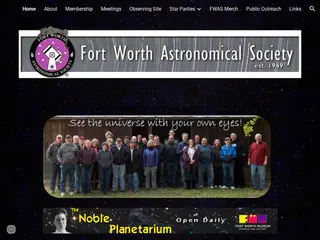
https://fortworthastro.com/
The Fort Worth Astronomical Society (FWAS) has been bringing amateur astronomy to North Texas since 1949, making it one of the oldest and largest such clubs in the country with over 200 active members. Visitors can find information on membership, club meetings, dark sky observing sites, star parties, and public outreach events conducted for local schools and organizations.
https://jmol.sourceforge.net/
Jmol is a free, open-source Java application and HTML5 tool for visualizing chemical structures in interactive 3D, supporting molecules, crystals, biomolecules, and materials. The project offers downloadable binaries, extensive scripting documentation, demos, and a community mailing list, making it a go-to resource for chemistry education and research.

http://smallwonderqrp.blogspot.com/2019/04/fiero-compact-qrp-ssbcw-transceiver.html
K.P.S. Kang's blog dedicated to QRP (low power) radio transceiver design, featuring detailed technical write-ups on homebrew SSB/CW transceivers like the FIREO, which uses an innovative FM limiter circuit for speech compression. A must-read for ham radio enthusiasts interested in minimalist radio construction and RF engineering theory.
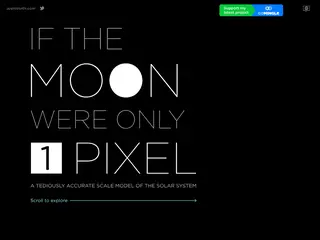
https://joshworth.com/dev/pixelspace/pixelspace_solarsystem.html
Created by Josh Worth, this site presents a scale model of the solar system where the Moon is reduced to a single pixel, requiring visitors to scroll endlessly through vast empty space to appreciate the true distances between planets. The experience is both humbling and educational, with witty commentary along the way and the ability to toggle between kilometers, miles, AU, and other quirky units of measurement.
https://www.qsl.net/kb9ocq/index.html
Dale Catron (KB9OCQ) built this ham radio personal page focused on the 2-meter band, featuring antenna specs, repeater information, and a dense collection of links covering equipment brands like Icom, Yaesu, Kenwood, and Alinco. The site also includes FCC rules, online practice exams, ARRL resources, and participation in multiple amateur radio webrings from the late 1990s.

https://inter-sol.org/
The INTER-SOL Programme (ISP), run by Volkssternwarte Paderborn e.V. in Germany, is an international citizen science initiative coordinating daily sunspot observations by amateur and professional astronomers since 1977. The site offers fundamentals about the sun, methods of sunspot counting and registration, an observers network, photo galleries, and INTER-SOL data archives, all presented in both English and German.

http://astrosurf.com/benoit/ngc.html
A comprehensive index of the entire New General Catalogue (NGC), organized into batches of 100 objects spanning all 7,840 entries, created by an amateur astronomer named Benoit. This deep-sky reference resource gives stargazers and astronomy enthusiasts a structured way to browse every NGC object from galaxies and nebulae to star clusters.